








CULLMAN, Ala. – Cullman County residents who install a qualifying storm shelter this year could receive an Alabama income tax credit of up to $3,000, but waiting until tax-filing season to apply could cost them their eligibility.
The Cullman County Emergency Management Agency is reminding residents that applications and supporting documents must reach the Alabama Emergency Management Agency during the same calendar year the shelter is constructed or installed.
For qualifying installations completed in 2026, that means submitting a complete application by Dec. 31.
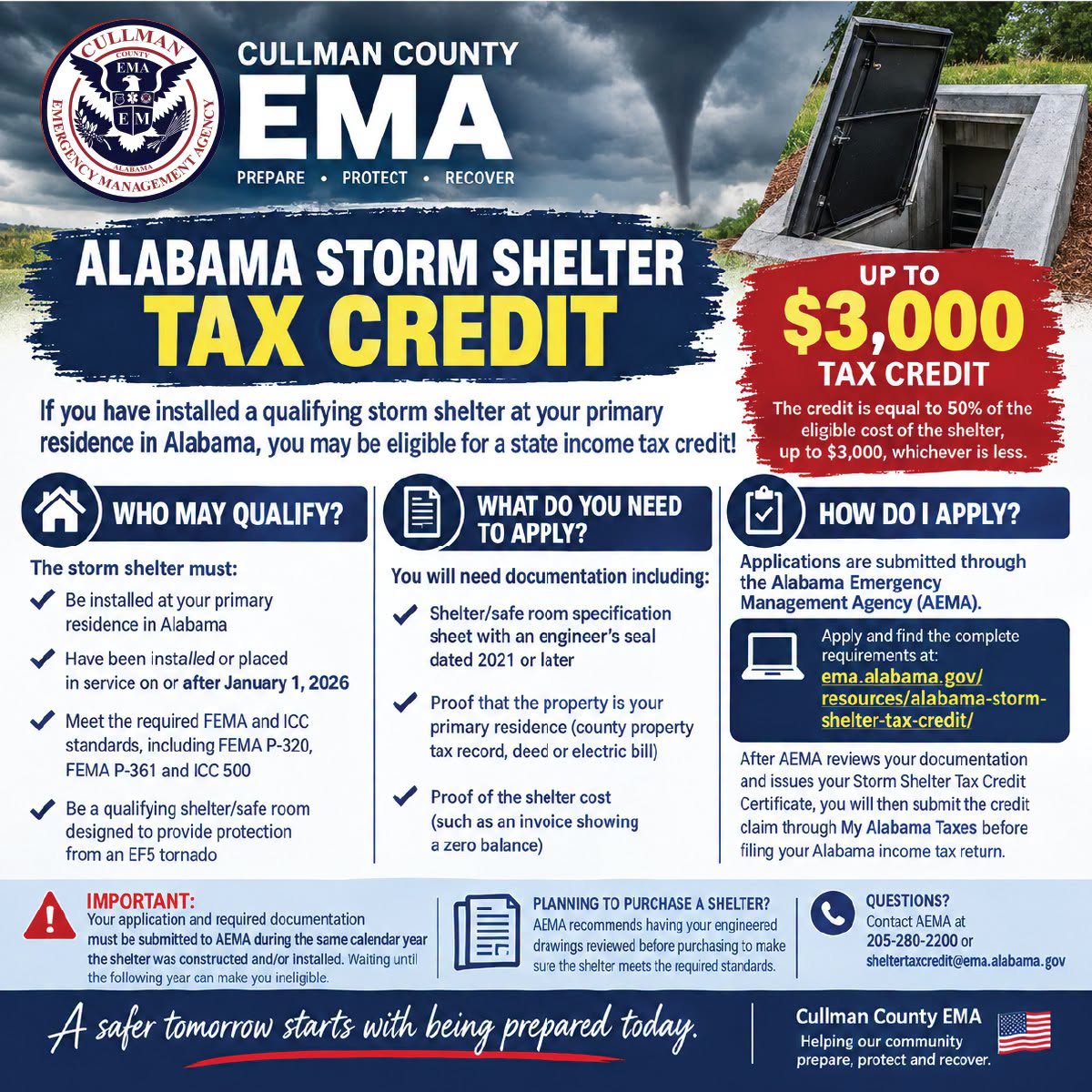
“Waiting until the following year can make you ineligible,” Cullman County EMA said in its informational post.
The credit equals 50% of eligible shelter construction, purchase and installation costs, up to a maximum of $3,000.
A shelter with $4,000 in eligible costs, for example, could qualify for a $2,000 credit.
Eligible costs of $6,000 or more would reach the $3,000 maximum, subject to approval and the taxpayer’s state income tax liability.
The credit is nonrefundable, meaning it cannot reduce that liability below zero. Unused credit cannot be carried forward to another tax year or transferred to someone else, according to the Alabama Department of Revenue.
Costs covered or expected to be covered by reimbursements, grants or other government assistance must be excluded from the eligible amount.
To qualify under AEMA’s current application guidance, the shelter must have been installed on or after Jan. 1, 2026, at the taxpayer’s primary residence in Alabama.
Cullman County EMA said qualifying shelters or safe rooms must be designed to provide protection from an EF5 tornado.
AEMA specifies compliance with FEMA P-320, dated March 2021; FEMA P-361, dated April 2021; and ICC 500, the 2020 edition. Applicants must provide engineered documentation demonstrating compliance.
Required documents include a shelter or safe room specification sheet bearing an engineer’s seal dated 2021 or later, proof of primary residence and proof of shelter costs.
Examples of residency documentation include a county property tax record, deed or electric bill.
AEMA lists an invoice showing a zero balance as proof of acquisition or installation costs.
Residents considering a purchase can send a complete set of engineered drawings to AEMA for review before committing to a shelter.
The application and tax claim are separate steps. Residents first submit their application and documentation to AEMA. If approved, the agency issues a Storm Shelter Tax Credit Certificate.
The taxpayer must then submit a credit claim through My Alabama Taxes before filing an Alabama income tax return.
The Department of Revenue says the claim must use the name and identifying information of the person listed on the certificate, including when filing a joint return.
A My Alabama Taxes account is not required to complete that process.
After approval, the credit is reported on Schedule OC with the state income tax return. The department says the credit must be claimed for the tax year in which the certificate is issued.
Statewide credits are capped at $2 million annually. The Department of Revenue lists the program as available through the 2028 tax year, but each applicant must still meet the deadline tied to the year of construction or installation.
Application information and the submission portal are available on AEMA’s Alabama Storm Shelter Tax Credit webpage at https://ema.alabama.gov/resources/alabama-storm-shelter-tax-credit.
For eligibility and application questions, contact AEMA at 205-280-2200 or sheltertaxcredit@ema.alabama.gov.