




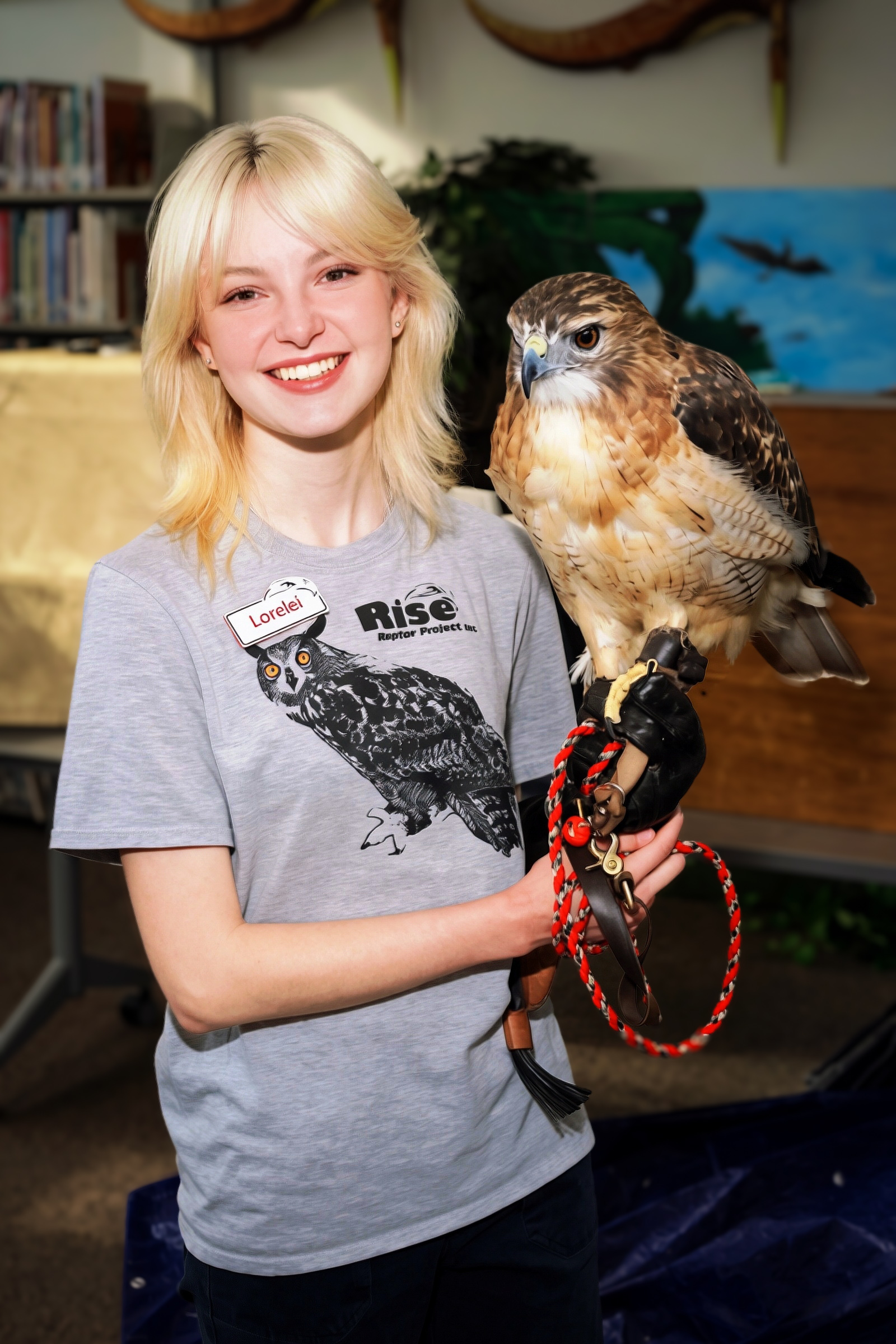
CULLMAN, Ala. – The Rise Raptor Project out of Huntsville visited the Cullman County Public Library on July 6. Nikki McElroy and her daughter Lorelei McElroy showered the audience with an abundance of knowledge.
They showed off three of their birds of prey, including Blue the male American Kestrel, who is a small falcon with outstanding vision but limited flight after an injury; Sassy the Red Tailed Hawk, who is a large soaring hunter with powerful feet; and Maximus the Eurasian Eagle Owl, a nocturnal hunter with facial disks, asymmetrical ears and silent flight.
They started off with a quick introduction, Nikki mentioned that she and her daughter have been with the nonprofit Rise Raptor for nine years. Rise, she said, stands for Raptors Inspiring Stewardship Through Education. She said she hopes she and the rest of the team can inspire others to take care of the world around them where these beautiful birds of prey reside.
Before showing the birds, Nikki and Lorelei quickly went over three core adaptations raptors share: exceptional eyesight, a hooked upper beak and strong feet with talons. These define birds of prey and determine hunting strategies.
Blue the male American Kestrel was first, “Now we can find this guy all over the place,” Nikki said. She informed the audience that the American Kestrel is the smallest falcon in North Alabama. Blue eats many different things like small field mice, lizards, dragonflies and even grasshoppers. “Other small birds, he would catch those while they’re flying. American Kestrels are incredible hunters.” She also said that with the American Kestrel you can tell the difference in gender based on the colors of their feathers. And on those feathers under the eyes are mustache marks or malar stripes that help them with the glare of the sun, much like how ball players put black face paint under their eyes to help with the bright stadium lights.
Unfortunately for Blue, he can only fly about 6 feet due to a broken wing that went untreated before he was found. However, he found himself to be in great care with the team’s help. He became the ambassador for his species nine years ago.
Nikki said the American Kestrel struggles with habitat loss. “I don’t know about Cullman, but in Huntsville and Madison, every field we have is being eaten up by apartment complexes or houses, neighborhoods and things like that. Unfortunately that means a loss of habitat for them.” She said that because they also eat bugs, they are being poisoned by toxic pesticide sprays as well.
Moving to the second raptor, Nikki said, “She’s going to be impressive. Sassy, coming out, is probably the most common raptor in Alabama.”
It was Lorelei who had the honor of telling the crowd about this bird of prey, and Sassy was indeed impressive. As she got her out, Lorelei joked with the young audience, “All right, this is Sassy, and she is our Red-Tailed Hawk. And after she poops, I will turn her around so you can see her red tail, but right now it’d be a little dangerous.” The children giggled at the thought.
Lorelei said most Red-Tailed Hawks are found resting on power lines or soaring overhead in the sky. Using her sharp eyesight she can see long distances, allowing her to hunt from hundreds of feet up in the air.
Lorelei gave a great example to the children to demonstrate just how well a Red-Tailed Hawk can see. “If you could imagine yourself on a football field and imagine that Sassy was sitting on one goalpost and you were standing at the other goalpost while holding up a newspaper, she would be able to read the title of that paper.”
Red-Tailed Hawks have the ability to lock their talons, acting as a zip tie in their feet. It not only helps them hold on to their perch, but also helps with hunting and taking their meal to safer locations.
They eat things like rats, mice, squirrels, chipmunks and rabbits. And if they have the opportunity they aren’t shy about going after smaller birds, like chickens. They even go as far as eating bats; yes, these birds of prey are not picky.
Sassy is a good 3 pounds with a 3-foot wingspan. As if understanding she was being doted on, Sassy flapped her wings at full length with impressive force. And just like that the magic was over and the children squealed with laughter as Sassy defecated. Lorelei, while chuckling, said, “That was a good one. Like other birds, Sassy is a nest builder, and to keep the nest clean they will actually shoot the feces out of the nest and it’s called slicing a mute.”
Sassy is originally from Illinois, where she was found in a neighborhood begging for food. Realizing this was clearly not normal behavior, and later finding out that most likely she had been imprinted on by a human and was kept illegally, she was sent to a wildlife rehabilitation center where she eventually landed in Rise Raptor’s care.
Sassy, unfortunately, is blind in her left eye; she was deemed unreleasable. But, just like Blue, she has found herself in great care.
The last bird was the wise Maximus, the Eurasian Eagle Owl. Native to Europe and Asia, Maximus has incredible hearing. “So their hearing with their ears being asymmetrical, they can hear side to side, up and down; it’s kind of like having surround sound,” the children were told. And despite popular belief, owls cant actually turn their heads all the way around. But, they do have 14 vertebrae, unlike humans who only have seven, making their necks still very flexible.
Owls have such flexible necks because their eyes are so big they can’t move. Nikkie joked, “That means he can’t give us attitude by rolling his eyes at us.” An owl of his size is also surprisingly quiet during flight, she said. “If other birds flew over your head you’d duck, but if Maximus flew over you, you would just get a beautiful gust of wind; there would be no noise at all.”
The crowd was also surprised to find out that, despite his incredible size, Maximus was actually small compared to his female counterparts. “A female would be about 30% larger, and while Maximus is 5 pounds a female would be about 8 pounds.”
Maximus is 15 years old and could easily live for 40 years in captivity.
The Rise Raptor Project hopes to inspire the young and old to look out for birds of prey in the wild.
Find out more at www.riseraptor.org.