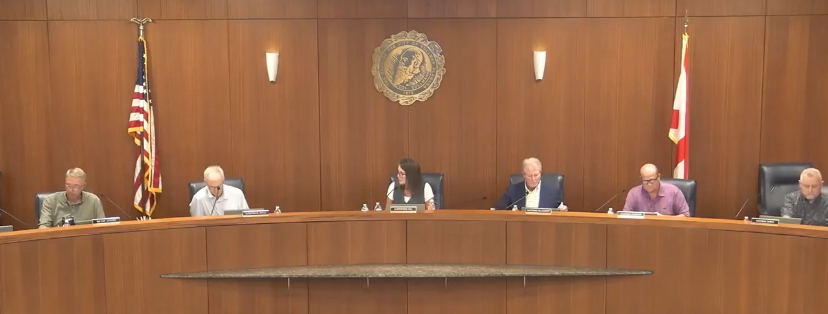
CULLMAN, Ala. – The Cullman City Council at its meeting on Monday, June 22, adopted a temporary moratorium on data centers.
What is a data center?
According to The Brookings Institution:
“Data centers host a large number of file servers and networking equipment that can store, process, and analyze text, images, code, and other information sources. Guided by large language models (LLMs) and machine learning, data centers can parse through these materials and act autonomously upon the derived insights. The applications that are hosted at these facilities can summarize text, edit photos or videos, examine data, code software, and perform many administrative and financial tasks in real time. These applications offer tremendous convenience, efficiency, and effectiveness to consumers, businesses, and governments.
“‘Hyperscale’ data centers typically have more than 5,000 file servers within their facilities and can house equipment utilized by many different organizations. With the large-scale growth of generative AI, there is tremendous reliance on data centers that process information quickly and with low latency to enable the use of a wide range of AI services and agents.”
The council adopted Resolution No. 2026-116 to impose a temporary moratorium on “the acceptance, processing, and approval of applications for the development, construction, expansion, or operation of data centers within the corporate limits of the city of Cullman.”
The resolution reads, in part:
WHEREAS, the City of Cullman, Alabama, is committed to protecting the public health, safety, morals, and general welfare of its residents, preserving the City’s unique character as a community with German heritage founded in 1873, and promoting orderly and sustainable growth consistent with its comprehensive plan; and
WHEREAS, data centers are large-scale industrial-style facilities primarily dedicated to the storage, processing, and transmission of digital data, typically involving extensive server equipment, significant electrical power demands, water usage for cooling, backup generators, noise from cooling systems, increased traffic, and demands on municipal infrastructure such as electricity, water, and wastewater systems; and
WHEREAS, the City Council finds that the rapid emergence and potential proliferation of such facilities require careful study of their compatibility with the City’s existing zoning districts, infrastructure capacity, environmental resources, residential quality of life, and long-term economic development goals; and
WHEREAS, pursuant to the authority granted to municipalities under Title 11 of the Code of Alabama 1975 (including Sections 11-52-70 et seq. and related provisions governing zoning and land use regulation), the City has the power to regulate land uses and impose temporary moratoria to allow time for comprehensive planning, zoning amendments, and impact studies; and
WHEREAS, neighboring Alabama municipalities, including the City of Birmingham (which has implemented a six-month moratorium) and the City of Leeds (which has implemented a one-year moratorium), have recently taken similar actions to study data center impacts; and
WHEREAS, the City Council desires to impose a temporary moratorium to pause new data center-related applications while the Planning Commission, City staff, and consultants conduct necessary reviews, public engagement, and potential updates to the Zoning Ordinance and other relevant regulations; and
WHEREAS, this moratorium is intended to be temporary, uniform in application, and not directed at any specific project or property in a manner constituting spot zoning
The city is not alone in its action. According to the Associated Press, “Political and local opposition has been growing because of fears about blackouts, rising electricity bills and the centers’ voracious water needs. Some states are suspending tax breaks or considering moratoriums on data center construction.”
They went on to address Ordinance No. 2026-42, which would prohibit the development and operation of data centers in city limits. No action was taken since the council will need to refer to the Cullman City Planning Commission on the ordinance.
The city council noted that prohibiting data centers will help provide the best quality of life for residents, proper infrastructure capacity, local resources, planned uses, conserve property values and support sustainable economic development aligned with the city’s priorities.