










Permit authorizes 60,000-GPD design flow of treated domestic wastewater; ADEM says no Smith Lake water-quality model currently exists
CULLMAN, Ala. – The Alabama Department of Environmental Management has issued a wastewater discharge permit for the planned Vista Lago Smith Lake Development in Bremen that the agency says represents something not previously permitted on Lewis Smith Lake.
In a May 27 response to public comments, ADEM said Vista Lago’s permit would be the first National Pollutant Discharge Elimination System permit to directly discharge into Lewis Smith Lake.
“Yes, this would be the first NPDES permit to directly discharge to Lewis Smith Lake,” ADEM stated.
The agency issued NPDES Permit AL0084516 to Maverick Construction LLC on May 27. It became effective June 1 and expires May 31, 2031.
The permit identifies the receiving water as Ryan Creek (Smith Lake) and authorizes the discharge of treated domestic wastewater from a planned wastewater treatment plant serving the Vista Lago residential development.
The distinction between treated wastewater and raw sewage is important.
Nothing in the permit authorizes the routine discharge of untreated sewage into Smith Lake. ADEM describes the permitted discharge as treated domestic wastewater, and the application states there are no significant industrial wastewater contributors to the system.
ADEM identified four existing NPDES facilities in the Lewis Smith Lake drainage area: Cold Springs School WWTP, Good Hope WWTP, Double Springs WWTP and Addison Lagoon and Sprayfield. The agency said none directly discharge into Lewis Smith Lake.
That makes the terms of Vista Lago’s permit, and the analysis behind them, central to the debate over development and wastewater treatment on Smith Lake.
What the permit authorizes
Vista Lago’s application lists a design flow of 0.060 million gallons per day, or 60,000 gallons per day, serving an estimated population of 300.
That is the system’s design capacity. It does not mean 60,000 gallons are currently being discharged into Smith Lake each day.
Key elements of the proposed system include:
- Vista Lago is classified as a new wastewater facility.
- Final plans and specifications must be submitted to and examined by ADEM before the treatment facility is constructed.
- Before operation, a licensed Alabama professional engineer must certify that the facility was built in accordance with the plans and specifications submitted to ADEM.
- Outfall 1 is listed as 100 feet from shore, with a depth below surface of 0 feet and an average daily flow of 0.060 MGD.
- The application describes the discharge as continuous throughout the year.
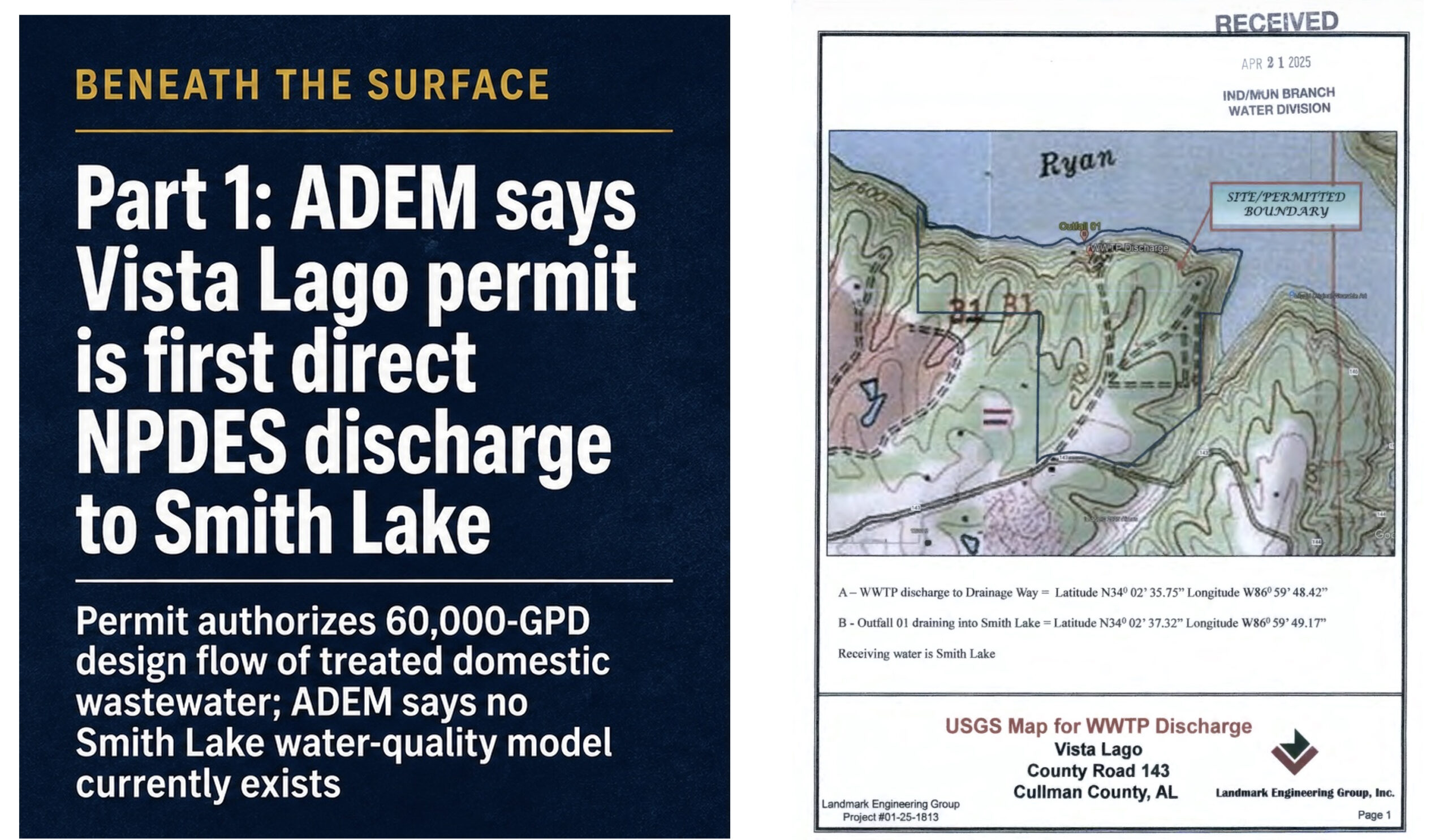
- Landmark Engineering Group identifies the receiving water as Smith Lake.
- Engineering drawings show two treatment trains, each designed for 30,000 gallons per day.
- The treatment schematic includes flow equalization, anoxic treatment zones, clarification, chlorination and phosphorus treatment.
Landmark’s map identifies Point A as the wastewater treatment plant discharge to a drainage way and Point B as Outfall 01 draining into Smith Lake.
What the permit requires
The permit establishes pollutant limits and recurring monitoring requirements rather than simply authorizing wastewater to flow from the development to the lake.
Among its principal requirements:
- E. coli: monthly average of no more than 126 colonies per 100 milliliters and daily maximum of 235.
- Carbonaceous biochemical oxygen demand: monthly average limit of 25 milligrams per liter.
- Ammonia-nitrogen: monthly average limit of 20 milligrams per liter.
- Dissolved oxygen: minimum of 6 milligrams per liter.
- Total residual chlorine: daily maximum of 1 milligram per liter.
- CBOD, dissolved oxygen, E. coli, ammonia, pH, chlorine and suspended solids: generally monitored weekly.
- Total Kjeldahl Nitrogen, nitrate plus nitrite and total phosphorus: monitored monthly from April through October.
Because Ryan Creek (Smith Lake) is classified for Swimming and Fish and Wildlife, ADEM imposed its swimming-classification E. coli limits year-round.
The permit does not impose numeric total nitrogen or total phosphorus discharge limits at startup.
ADEM said it conducted a narrative nutrient reasonable-potential analysis and imposed monitoring so sufficient information would be available to determine whether nutrient limits should be added later.
Because Vista Lago is a new discharge, ADEM said it could not complete a reasonable-potential analysis using discharge-monitoring-report data from an operating history.
No Smith Lake water-quality model
One of the most notable statements in the permit file appears in a Dec. 4, 2025, memorandum from ADEM’s Water Quality Branch.
“A water quality model for Smith Lake has not been developed at this time,” the agency wrote.
ADEM instead used best professional judgment, or BPJ, in its wasteload-allocation analysis and conducted a site visit Oct. 31, 2025.
The agency concluded the proposed limits should protect water quality in Ryan Creek (Smith Lake).
The permit rationale states that if a Smith Lake water-quality model is developed, it can be used to further evaluate Vista Lago’s discharge and determine whether permit limitations should be revised.
The receiving segment is also identified as a Tier I waterbody on Alabama’s 303(d) impaired-waters list for mercury, resulting in a requirement for annual mercury monitoring.
The permit file does not identify a total maximum daily load affecting the Vista Lago discharge. The 303(d) listing is not evidence that Vista Lago is responsible for mercury already present in the waterbody.
Two nutrient descriptions require clarification
Vista Lago’s application contains descriptions of nutrient treatment that are not explicitly reconciled in the permit file.
The documents state:
- EPA Form 2A lists design removal rates of 95% for BOD or CBOD and suspended solids and 90% for phosphorus, nitrogen and ammonia.
- The overall treatment schematic depicts anoxic treatment zones and a separate phosphorus-treatment step.
- Another detailed wastewater-treatment-plant drawing states the WWTP design will not remove phosphorus or nitrogen from influent wastewater “to any significant degree.” It states that influent ammonia will instead be converted to nitrites and nitrates.
The overall schematic’s additional treatment components could mean the documents describe different portions of the complete system.
However, the permit package reviewed by The Tribune does not explicitly reconcile the descriptions.
The file also does not provide a clear calculation showing how the overall system reaches the 90% phosphorus and nitrogen removal rates listed on Form 2A or the expected concentrations and pounds per day of those nutrients leaving the plant.
That is one of the technical questions The Tribune is seeking to clarify with the project engineer and ADEM before the system begins operation.
Failure and backup requirements
The permit also addresses treatment-plant failures, power loss and sanitary sewer overflows.
Its requirements include:
- If treatment facilities or the primary power source fail, Maverick must cease, reduce or otherwise control discharges as necessary to remain within permit limits until treatment is restored.
- If alternate power, standby generators or retention of inadequately treated wastewater will be used during a power failure, the permit requires certification that those controls have been installed.
- Preliminary drawings show approximately 11,700 gallons of flow-equalization capacity and about 21,100 gallons of sludge-holding capacity.
- Maverick must develop a Sanitary Sewer Overflow Response Plan within 120 days of the June 1 permit effective date.
- The SSO plan must be fully implemented no later than 180 days after the effective date.
- Once developed, the plan must be made available to the public within 30 days of a written request, although certain security-sensitive information may be redacted.
The documents reviewed by The Tribune do not identify the equalization volume as dedicated emergency storage or state how long the system could retain incoming sewage during a prolonged outage while operating at or near design flow.
The timetable also means the absence of a completed SSO plan immediately after the permit was issued does not constitute a missed permit deadline.
Who is responsible long term?
ADEM’s current records identify Maverick Construction LLC and managing member Nathan Stoops as the responsible parties.
Maverick is listed as both owner and operator in the permit application.
The permit further requires:
- The wastewater operator in responsible charge must be identified to ADEM after wastewater is introduced into the system.
- A change in permittee, ownership or control requires notice to ADEM and permit modification or reissuance.
- The permit cannot simply be transferred to another entity without agency involvement.
The documents reviewed by The Tribune do not identify what entity, if any, is intended to assume ownership and financial responsibility for the wastewater system after Vista Lago is fully developed.
That question extends beyond construction because the permit requires continuing operation, sampling, laboratory testing, equipment maintenance, repairs and regulatory compliance.
What the application says about alternatives
Vista Lago’s application presents the centralized plant as an environmental alternative to individual septic systems.
Asked what environmental or public-health problem the proposed discharge would address, the applicant said the system would “reduce environmental impact” through a decentralized wastewater treatment plant instead of individual septic systems.
The application describes the project’s public service as providing sanitary sewer to the development and its economic benefit as economical wastewater treatment.
The permitting submission considered several alternatives:
- Land application
- Connection to an existing publicly owned treatment works
- Relocation
- Reuse or recycling
- Other treatment technologies
- Onsite or subsurface disposal
Extended aeration was selected.
ADEM ultimately classified the receiving segment as Tier I rather than Tier II. As a result, the applicant was not required to make the more stringent Tier II showing that the discharge was necessary for important economic or social development.
During the public-comment process, ADEM was asked to require Vista Lago to redesign its sewer system to conform with nondischarge systems used elsewhere around Smith Lake.
ADEM responded that it does not have regulatory authority to require a particular treatment-system design or require a nondischarge system.
ADEM has answered the permitting question by issuing AL0084516.
Once the system becomes operational, compliance will turn on whether the permittee meets the limits and conditions contained in that permit.
The broader policy question is whether a direct NPDES-permitted treated-wastewater discharge should become part of Smith Lake’s wastewater infrastructure.
Those are related but distinct questions.
In Part 2 of “Beneath the surface,” The Tribune will examine the four existing wastewater permits ADEM identified within the Lewis Smith Lake drainage area, where those facilities discharge and how their wastewater reaches, or does not reach, Smith Lake.