Flock series, part 1
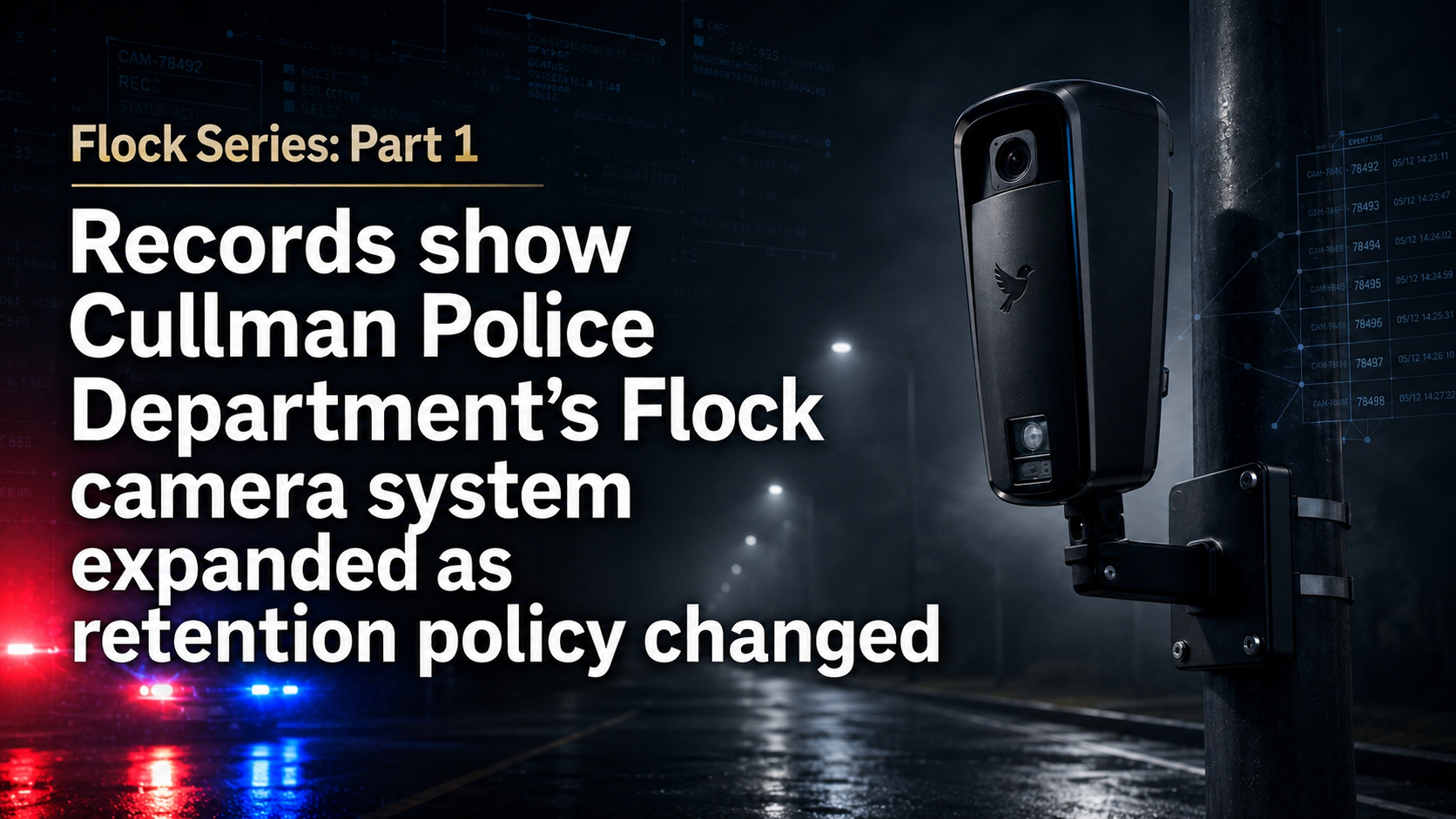
CULLMAN, Ala. – Public records obtained by The Cullman Tribune show the Cullman Police Department’s automated license plate reader (ALPR) system has expanded over several years, while the department’s current policy allows captured data to be retained longer than the 30-day period listed in the original Flock Safety order form.
The Cullman Tribune obtained documents through open records requests for this article.
This is the first in a three-part series by The Tribune examining public records, policies and agency responses related to Flock Safety ALPR cameras in the Cullman area. This article focuses on the Cullman Police Department. Later articles will focus on Hanceville, Wallace State Community College and the Cullman County Sheriff’s Office.
Cullman City Council President Kim Hall said the city views the technology as a public safety tool while also recognizing the importance of public trust.
“Advanced technological tools are available for law enforcement to provide for the public safety of our community, citizens and visitors,” Hall said. “Public safety and public trust go hand in hand, and we are committed to supporting both as we continue to serve the citizens of Cullman.”
The records reviewed by The Tribune include:
- Flock Safety order forms
- Invoices
- Policy documents
- A camera list
- A redacted audit spreadsheet
- A sharing spreadsheet
- City correspondence
The Tribune is not publishing a full map of camera locations or camera angles. The records reviewed show the system is concentrated along major entrances, highway routes, business corridors and key intersections.
The documents also show the system is connected through Flock sharing settings to agencies outside Cullman.
The city produced a sharing spreadsheet with columns labeled “Organization Name,” “Networks Shared With Me” and “Networks I’m Sharing.”
The Tribune is not characterizing every listed organization as having identical access or unlimited search authority. The record shows CPD’s system was connected through Flock sharing settings to agencies beyond the city.
What the system does
Flock Safety’s order forms and product descriptions describe the company’s license plate reader cameras as devices that capture license plate information and vehicle attributes.
The records describe tools that allow law enforcement to search by:
- Time
- Location
- Full plates
- Partial plates
- Temporary plates
- Vehicle type
- Make
- Color
- License plate state
- Missing or covered plates
- Features such as bumper stickers, decals and roof racks
The documents also describe FlockOS features such as community camera access, license plate lookup, vehicle fingerprint search, real-time National Crime Information Center alerts, custom hot lists, state network access and nationwide network access.
The system can create a searchable record of where and when a vehicle was captured. It can compare plates to wanted, missing, stolen or locally entered lists. It can also allow investigators to search across multiple cameras and, depending on access, broader Flock networks.
Alabama rules governing license plate readers require LPR data to be used for criminal justice or public safety purposes. Those rules also require agencies to maintain logs showing who accessed the data, when it was accessed and the purpose for the access.
Cullman’s Flock system
The City of Cullman’s main Flock Safety order form identifies the customer as “AL – Cullman PD.”
CPD can purchase equipment and enter vendor contracts with Cullman City Council approval.
The city’s main Flock order form lists:
- A 36-month initial term
- A 24-month renewal term
- 16 Flock Safety Falcon cameras
- FlockOS
- A $44,900 first-year subtotal
- A $40,000 annual recurring subtotal
- A $124,900 contract total
The order form is signed by Flock Group Inc. on Dec. 20, 2023.
The customer signature page shows then-Chief David Nassetta signing for AL – Cullman PD on Dec. 19, 2023.
A separate invoice dated Dec. 31, 2024, bills AL – Cullman PD $40,000 for 16 Flock Safety Falcon cameras at $2,500 each. The invoice states it was year two of a 36-month term for 2024-2025.
The city later added an LPR trailer.
The trailer order form lists:
- A 36-month initial term
- A 36-month renewal term
- $11,500 due at contract signing
- A $10,000 annual recurring subtotal
- A $31,500 contract total
The trailer invoice is dated Oct. 13, 2025. It bills the city $10,000 for an LPR Trailer – Radar Speed Sign subscription and $1,500 for trailer delivery.
A camera list produced in the records identifies city Flock installations beginning in December 2020. The list also shows additional installations in 2021, 2024 and 2025.
The list includes 18 numbered camera entries and one trailer entry.
The 2024 and 2025 installations show the city system expanded beyond the earlier listed locations.
Retention period
The records show a change in the listed retention period.
The City of Cullman’s original Flock order form listed a 30-day retention period.
The current Cullman Police Department ALPR policy, published in February 2026, says the department will coordinate with the approved vendor to ensure all stored ALPR data is retained for no more than five years.
After that, the policy says ALPR data should be purged unless it has become evidence, is reasonably believed to become evidence, is subject to discovery or is otherwise subject to a lawful action to produce records.
The city’s current policy allows retention up to the maximum period permitted under Alabama’s LPR rules, rather than the 30-day period listed in the original Flock contract documents produced to The Tribune.
The policy also says notice must be sent to the Alabama Law Enforcement Agency when data is retained beyond the retention period.
CPD policy
The Cullman Police Department’s ALPR policy is labeled Policy 423 and was published through Lexipol.
The policy says its purpose is to provide guidance for the capture, storage and use of digital data obtained through ALPR technology.
The policy states that:
- CPD uses ALPR technology to capture and store digital license plate data and images while recognizing established privacy rights.
- All data and images gathered by the ALPR are for official use.
- Because the data may contain confidential information, it is not open to public review.
- ALPR data should be accessible only through a login and password-protected system capable of documenting access by name, date and time.
- ALPR data may be shared only with other law enforcement or prosecutorial agencies for official law enforcement purposes or as otherwise permitted by law.
- Outside agency requests should include the agency name, the person requesting the information and the intended purpose.
- Approved requests should be retained on file.
The policy lists several law enforcement purposes for ALPR use. Those include identifying stolen or wanted vehicles, stolen license plates and missing persons.
It also says the system may be used to gather information related to active warrants, homeland security, electronic surveillance, suspect interdiction and stolen property recovery.
One section states that an ALPR may be used with any routine patrol operation or criminal investigation. The same section states that reasonable suspicion or probable cause is not required before using an ALPR.
The policy says officers should, when practicable, verify an ALPR response through an appropriate official law enforcement database before taking enforcement action based solely on an ALPR alert.
What the city produced
The Tribune’s April 2 records request to the City of Cullman sought records related to CPD’s use of ALPR systems.
The request included contracts, funding records, camera deployment records, policies, procedures, access records, sharing records, usage data, performance metrics, complaints and oversight records.
The city’s public records form was marked approved, with no charge. The form noted that records were emailed April 13, 2026.
The city provided Flock camera order forms, billing schedules, invoices and policy documents. Records reviewed by The Tribune also included a city sharing spreadsheet and a redacted audit spreadsheet.
The city sharing spreadsheet listed organizations, networks shared with CPD and networks CPD was sharing. The “Networks I’m Sharing” column repeatedly listed “Cullman AL PD” and “Cullman AL PD – Flex.”
The city audit spreadsheet reviewed by The Tribune contained 567 rows from March 2026.
The spreadsheet listed:
- Users
- Time frames
- Redacted license plate fields
- Reasons
- Redacted case numbers
- Filters
- Search times
- Search types
The reasons visible in the audit included larceny/theft offenses, burglary or breaking and entering, missing or endangered person/runaway matters, motor vehicle theft or stolen vehicle matters, welfare checks, hit-and-run or car accident matters and property damage or vandalism.
The records do not show the outcome of each search. They do not show whether each search led to an arrest, a recovered vehicle, a warning, no enforcement action or another result.
What the city withheld
A memorandum from Chief Joey Duncan to City Clerk Pam Leslie said much of the requested information could not be released.
Duncan’s memo said the following records or details were exempt from disclosure:
- ALPR camera deployment details, including specific locations, installation information and internal system mapping
- Records that could compromise law enforcement operations or create security risks
- System audit logs, search history, investigative use and case-related outcomes
- Records involving interagency access, data-sharing practices or coordination with outside or federal agencies where disclosure could disrupt law enforcement cooperation or expose sensitive procedures
Duncan cited Alabama Code 12-21-3.1(b), court cases and a 2025 Alabama attorney general opinion.
“Accordingly, most of the requested records are exempt and will not be released,” Duncan wrote in the memo.
The memo said Flock camera order forms, policy, billing schedules for cameras and trailers and related invoices were being provided as responsive public records.
The Tribune is not asserting that every withheld record must be public.
The records show some information about access, retention, sharing, auditing and system use was released. Some was redacted. Some was withheld.
What remains unanswered
The records reviewed by The Tribune show:
- The city’s Flock system grew through multiple phases, beginning with installations listed in 2020 and expanding with later cameras and a trailer.
- The city’s main Flock agreement had a $124,900 contract total.
- The city later added an LPR trailer with a $31,500 contract total.
- The city’s original order form listed 30-day retention.
- The current CPD policy published in February 2026 allows ALPR data to be retained for no more than five years.
- The city produced a spreadsheet identifying organizations, networks shared with CPD and networks CPD was sharing.
- The system is used for criminal investigations and public safety matters such as theft, burglary, stolen vehicles, missing or endangered persons, welfare checks, crashes and vandalism.
- The system captures vehicle data without requiring reasonable suspicion or probable cause before ALPR use, as stated in CPD policy.
The documents reviewed do not show:
- A complete outcome report showing how many local arrests, convictions, stolen vehicle recoveries or missing person recoveries were directly tied to the system
- A complete public record of every outside agency request for Cullman-area ALPR data
- Whether any local users were disciplined for improper access
- Whether annual reports, audits or misuse findings required under Alabama’s LPR rules have been posted in a way that is easily accessible to the public
- How broad network searches are reviewed internally
- How the city documents that each search meets a criminal justice or public safety purpose
That places the system within routine law enforcement operations while also leaving unresolved questions about access, retention, sharing, audits, misuse findings and public reporting.
Part 2 of this series will examine Hanceville’s Flock camera system, the city’s police department dissolution and questions about how local camera access and control changed after the Cullman County Sheriff’s Office assumed law enforcement authority in Hanceville.
current-Flock-trailer-contactCurrent-main-Flock-contact
Flock-2025-annual-invoice-16-cameras
Policy
Records-Request-Noah-Galilee-ALPR-Systems-Flock-Safety-2026.04.02-2
trailer-2025-invoice