








Read part 1 at www.cullmantribune.com/2026/08/11/beneath-the-surface-part-1-adem-says-vista-lago-permit-is-first-direct-npdes-discharge-to-smith-lake.
CULLMAN, Ala. – Is Vista Lago really the first wastewater discharge permitted on Smith Lake?
ADEM’s answer is narrower than the shorthand often used in the public debate.
Wastewater treatment facilities already operate under National Pollutant Discharge Elimination System permits within the Lewis Smith Lake drainage area. According to ADEM, however, none directly discharge into Lewis Smith Lake.
That is what separates Vista Lago Smith Lake Development from the four existing facilities ADEM identified in its response to public comments on NPDES Permit AL0084516.
“Yes, this would be the first NPDES permit to directly discharge to Lewis Smith Lake,” ADEM stated in its May 27 response.
The agency identified Cold Springs School WWTP, Good Hope WWTP, Double Springs WWTP and Addison Lagoon and Sprayfield.
“None of them discharge directly into the lake,” ADEM stated.
Wastewater can follow different pathways within the same watershed. A treatment plant may discharge treated effluent into a creek or tributary. Another system may apply treated wastewater to land. A sanitary sewer system may experience an accidental overflow.
Those situations all involve wastewater, but they are not equivalent.
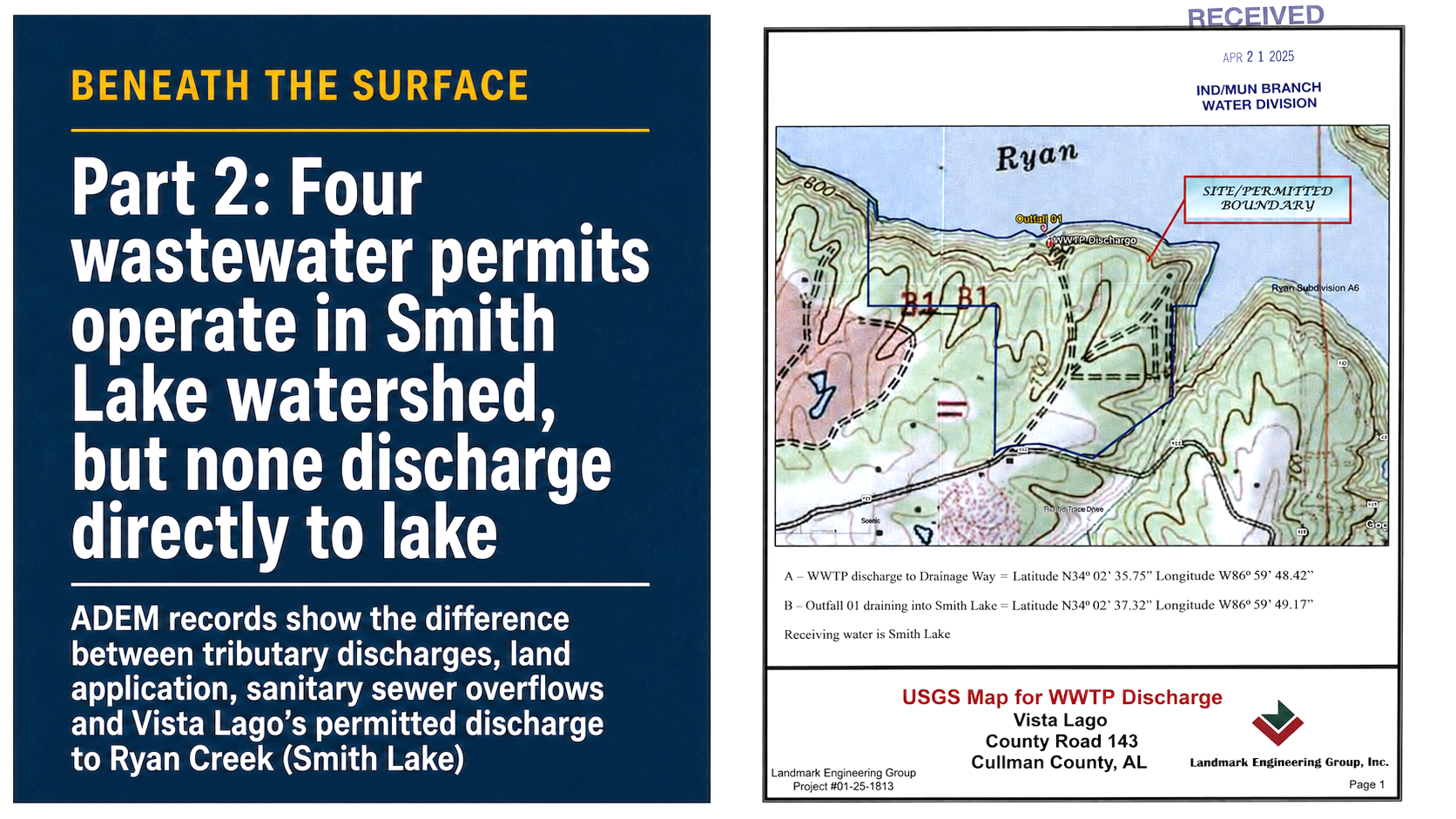
Vista Lago’s engineering records identify a local drainage way leading to Smith Lake, Outfall 01 draining into Smith Lake and Smith Lake as the receiving water. ADEM’s permit rationale identifies the receiving water as Ryan Creek (Smith Lake).
Understanding why ADEM considers Vista Lago different requires examining the four existing facilities.
Good Hope: A surface-water discharge, but not to Smith Lake
Good Hope has operated a wastewater treatment system for decades.
ADEM’s Municipal Outfalls mapping identifies Good Hope WWTP under NPDES Permit AL0058343, with Living Water Utilities LLC listed as the permittee and Station 001 classified as an external outfall.
A 1999 ADEM permit rationale identifies the receiving water for Good Hope’s treated effluent as Bavar Creek, which was classified for Fish and Wildlife use. The document listed a design flow of 0.200 million gallons per day at the time.
That historical flow figure should not be treated as the plant’s current permitted capacity. Its relevance here is the receiving water ADEM identified.
The spelling Bavar Creek is also consistent with geographic records and prior local government references to the waterway.
Good Hope is therefore an example of a permitted wastewater outfall within the broader Lewis Smith Lake drainage area without being a direct discharge into the lake.
An overflow is not the same as a permitted discharge
Good Hope also illustrates a separate wastewater issue that can become confused with routine permitted discharge.
On July 28, ADEM issued a notification concerning a sanitary sewer overflow associated with Living Water Utilities/Good Hope WWTP.
According to the initial report:
- The overflow began at a lift station at 5 p.m. July 27 and ended at 6 a.m. July 28.
- The estimated volume was greater than 1,000 gallons and no more than 10,000 gallons.
- The receiving-stream field was listed as “Ground Absorbed.”
It would be inaccurate to describe the overflow as Good Hope’s normal permitted wastewater discharge.
It would also be inaccurate, based on the report reviewed by The Tribune, to say the July overflow entered Smith Lake. ADEM’s initial report does not make that finding.
A sanitary sewer overflow is an unintended release. An NPDES outfall is a permitted discharge point operating under specified effluent limitations.
Vista Lago’s permitted outfall is the latter.
Concerns about future system failures are therefore separate from the treated-wastewater discharge authorized during normal operation.
Cold Springs: A tributary discharge
ADEM also identified Cold Springs School WWTP, NPDES Permit AL0051080, among the four existing permits in the Lewis Smith Lake drainage area.
A 1997 ADEM permit issued to the Cullman County Commission on Education identified the Cold Springs School wastewater treatment plant and authorized its discharge into an “unnamed tributary to Big Branch.”
The historical document is not being used to establish every term of the facility’s current permit. It establishes the receiving water ADEM identified at that time: a tributary rather than Lewis Smith Lake itself.
Water within a watershed can ultimately move through tributaries toward larger receiving waters, but that does not make every upstream NPDES outfall a direct lake discharge.
Double Springs: Treated wastewater to Clear Creek
ADEM identified NPDES Permit AL0065480, operated by the Double Springs Water and Sewer Board, among the four existing Smith Lake drainage-area permits.
In an April 2025 public notice concerning reissuance of the permit, ADEM said Double Springs WWTP on Bailey Road discharges treated domestic wastewater to Clear Creek, classified as Fish and Wildlife in the Black Warrior River Basin.
That is a surface-water discharge, but according to ADEM, it is not a direct discharge into Lewis Smith Lake.
The distinction becomes important when maps are used to argue that other wastewater plants are already “discharging into Smith Lake.”
A creek may lie within the Smith Lake watershed or ultimately contribute water downstream. That does not make a permit whose named receiving water is Clear Creek equivalent to one ADEM describes as directly discharging to Lewis Smith Lake.
Addison: Land application
The fourth facility identified by ADEM operates differently.
ADEM’s Municipal Outfalls map identifies Addison Lagoon and Sprayfield under NPDES Permit AL0075621, with the Town of Addison listed as the permittee.
Station 001 is identified as “Land Application,” rather than an external surface-water outfall.
Addison therefore belongs in the broader discussion of wastewater management within the Smith Lake drainage area, but its permitted disposal pathway differs from Vista Lago’s.
That is relevant because Vista Lago’s applicant considered land application among alternatives to a surface-water discharge.
The alternatives analysis submitted to ADEM lists land application, connection to an existing publicly owned treatment works, relocation of the discharge, reuse or recycling, onsite or subsurface disposal and other treatment technologies.
The application lists “Land not available” as the comment associated with land application.
The filing establishes that land application was considered. It does not establish that it was feasible for the development.
Direct does not mean untreated
“Direct discharge” does not mean “raw sewage.”
It describes the relationship between a permitted point source and its receiving water.
Vista Lago’s permit authorizes the discharge of treated domestic wastewater, with ADEM identifying Ryan Creek (Smith Lake) as the receiving water.
The four existing systems use different pathways:
- Good Hope discharges treated wastewater to Bavar Creek.
- Cold Springs historically discharged to an unnamed tributary to Big Branch.
- Double Springs discharges treated wastewater to Clear Creek.
- Addison uses land application.
Vista Lago is different because ADEM says its permit is the first NPDES permit to directly discharge to Lewis Smith Lake.
That does not, by itself, determine the environmental effect of the discharge.
It establishes what is new.
What does the 435-day figure mean?
Another number repeated throughout the debate is Smith Lake’s reported 435-day retention time.
The number has a credible basis.
Federal recreation information for Lewis Smith Lake lists:
- Approximately 21,200 acres of surface area
- About 500 miles of shoreline
- A watershed of approximately 944 square miles
- A maximum depth of 264 feet
- A retention time of 435 days
But retention time does not mean every gallon entering the reservoir remains at its point of entry for 435 days.
EPA defines hydraulic residence time as the average time required to completely renew a lake’s water volume. EPA also notes that longer residence times can give biological processes, including nutrient uptake and algal growth, more time to occur.
It would therefore be an overstatement to say every gallon released near Vista Lago will remain there for exactly 435 days.
The figure describes the reservoir as a whole. It does not establish the site-specific path, mixing or travel time of effluent entering through Ryan Creek.
That returns the discussion to a finding in Part 1: ADEM says a Smith Lake-specific water-quality model has not been developed and that the agency used best professional judgment in establishing Vista Lago’s initial limits.
The lakewide retention figure provides context about Smith Lake. It does not answer the more specific question of what happens to a permitted 60,000-GPD-design discharge entering through Ryan Creek.
What the four permits prove, and what they do not
After reviewing ADEM’s response, permit records and outfall information, two statements can simultaneously be true:
- Wastewater treatment facilities already operate within the Lewis Smith Lake drainage area.
- Vista Lago would represent the first NPDES-permitted direct discharge into Lewis Smith Lake.
ADEM itself says both.
The four existing permits do not establish that Vista Lago poses an unacceptable environmental risk. They also do not erase what ADEM identifies as the precedent created by its permit.
The July Good Hope overflow represents something different still: an accidental sanitary sewer overflow reported to ADEM, not a routine permitted effluent discharge.
The public argument over Vista Lago is therefore no longer about whether wastewater infrastructure exists somewhere within the Smith Lake watershed.
It plainly does.
The remaining dispute concerns the introduction of what ADEM identifies as the first direct NPDES-permitted treated-wastewater discharge to Lewis Smith Lake.
ADEM has made its permitting decision by issuing AL0084516.
The policy, engineering and public confidence questions surrounding that decision remain.
In Part 3 of “Beneath the Surface,” The Tribune will examine claims made by opponents, assurances made by the developer and statements from elected officials and compare them with the permit record.