





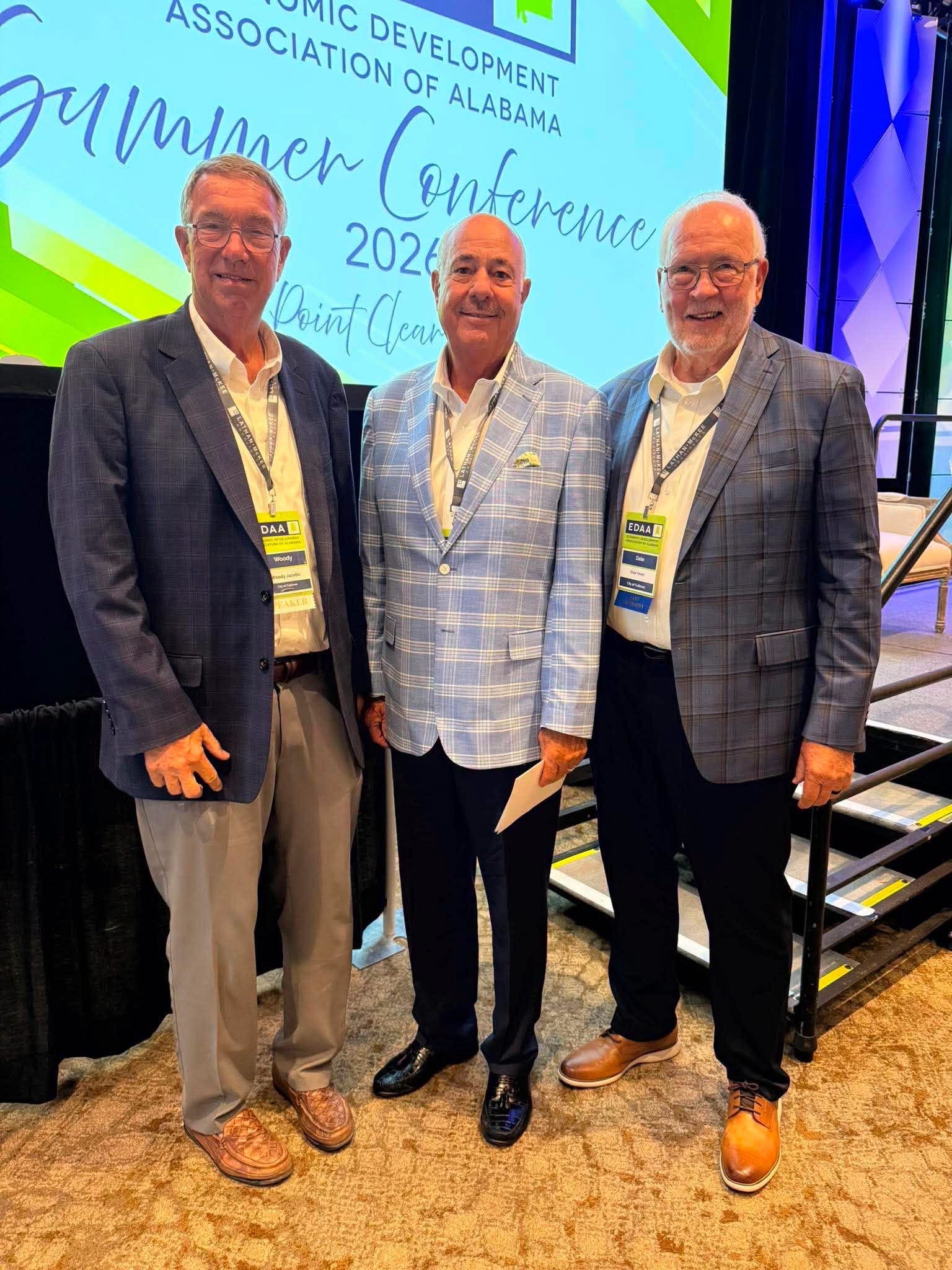
CULLMAN, Ala. – Cullman Mayor Woody Jacobs and former Cullman Economic Development Agency Director Dale Greer joined Alabama Department of Economic and Community Affairs (ADECA) Director Kenneth Boswell for a presentation at the Economic Development Association of Alabama Summer Conference. The event took place July 19-22, in Point Clear.
The session, “Partnership to Strengthen Alabama Communities: A Cullman Case Study,” focused on projects completed through partnerships involving the City of Cullman, ADECA and other organizations.
More than 550 people attended the conference.
The audience included economic development professionals, engineers, general contractors, construction companies, architects, Alabama Department of Commerce representatives and others involved in industrial recruitment and expansion.
The Cullman presentation was scheduled immediately before the conference’s Governor’s Luncheon, which featured Gov. Kay Ivey.
Boswell said ADECA selected Cullman to give attendees a local perspective on using the department’s programs and completing grant-supported projects.
“For ADECA’s presentation at the Economic Development Association of Alabama Summer Conference, we thought it would be a great opportunity for attendees from across Alabama to hear from local leaders who have taken advantage of the resources available at ADECA,” Boswell said. “There is no better example of that than the City of Cullman.”
Boswell credited Jacobs and the city’s leadership with developing projects that have produced benefits beyond the city.
“Mayor Jacobs and his team have a great vision for the city, and the projects that have been supported by ADECA grants benefit not only Cullman itself but also the surrounding area,” Boswell said.
Boswell uses his conference appearance annually to update economic development professionals on ADECA’s programs and available funding. Boswell asked Jacobs and Greer to discuss projects Cullman had completed and explain how the city worked through the process.
“He said rather than him taking 30 minutes and standing up and talking about all of his programs again, he wanted us to come down and tell them that we had completed numerous projects and explain how we did them,” Jacobs said.
Boswell said the presentation allowed Jacobs and Greer to discuss Cullman’s relationship with ADECA, its grant processes and the effects of completed projects.
“The story of Cullman’s partnership with ADECA, what it has been like to work through our grant processes and the tremendous boost that these projects have made in the community was a story I felt would help other communities,” Boswell said.
Projects discussed during the session included Depot Park, improvements to 24th Street associated with the REHAU expansion and an aviation and workforce development project at Cullman Regional Airport.
Depot Park, which was supported by a $500,000 Appalachian Regional Commission grant, and the pavement resurfacing of 24th Street for a REHAU expansion, supported by $700,000 in ARC and Community Development Block Grants (CDBG), were two projects Boswell highlighted. ARC funds are federal dollars administered through ADECA. CDBG funds are state appropriated dollars.
Grant money for Depot Park property helped fund infrastructure improvements.
The park is now used for Cullman’s Christkindlmarkt, Oktoberfest and Alabama Strawberry Festival and other events. Cullman Parks, Recreation & Sports Tourism reports attendance at the three festivals of more than 600,000 last year.
Jacobs described the ARC grant as seed money that helped the city begin preparing the property before additional investments were made.
Jacobs worked with consultants to draft a site plan, cost estimate, show the work to be done, describe the potential economic impact and the city commitment to share in the cost.
The presentation also addressed improvements to 24th Street completed in connection with an expansion at REHAU. Greer said portions of the roadway were the responsibility of both the city and county and that the overall work represented an approximately $1 million project.
According to Greer, the project received $350,000 through the CDBG program for job creation and another $350,000 through ARC from a special fund earmarked for automotive projects. The remaining costs were funded locally. ARC funds could be used to match the CDBG grant lowering the local government financial burden to $300,000.
Greer cited an aircraft maintenance hangar developed at Cullman Regional Airport to emphasis the importance of consulting with ADECA before taking action.
The airport already had maintenance services for piston-powered aircraft and was recruiting Martin Aviation to add jet maintenance capabilities.
No grants funds were available for a hangar, but there was assistance for projects that combined workforce training and aviation that could include a hangar.
City representatives met with Wallace State Community College to discuss aviation related instruction.
“The college and Martin Aviation worked together to form a partnership that let us successfully apply for a $1 million grant,” Greer said. “The result, a hangar and immediate jobs for Martin and a Wallace workforce complex training students for future aviation jobs.”
He continued, “Be flexible as an applicant and consult with the experts at ADECA. They can quickly make a project viable.”
ADECA projects illustrate the range of community, infrastructure and economic development needs that may qualify for assistance.
Cullman has obtained funding for recreation trails, industrial roads, airport improvements, Good Samaritan Health Clinic, Foundry Farm, The Link of Cullman County, sewer and water lines, a theater building and many others. Cullman County has tapped into grant resources as well.
The primary advice shared with attendees, Greer said, was to contact ADECA early, remain flexible and be prepared to adjust a project to meet funding requirements.
Greer said communities should not approach the agency with only a broad idea and an unsupported estimate.
Applicants should instead provide a defined project, preliminary cost information and evidence that the community has the ability and financial commitment to complete the work.
“You really need a consultant, an architect or somebody to help you with the concept so that you can see it,” Jacobs said.
ADECA staff members can help communities identify programs that may apply to a proposed project, according to Jacobs.
He said those conversations should begin before local decisions limit the agency’s available options.
Boswell described ADECA as a free source of consultation during the early stages of planning. Waiting too long to contact the agency can limit the ways the staff can assist.
Greer also said grants do not cover the full cost of a project. The applicant is nearly always required to have a financial investment in the project.
Local leaders should identify matching funds and determine whether the city, county or participating organization can complete the project before seeking assistance, he told attendees it was rewarding to have the agency recognize that Cullman had properly applied for funding, completed its projects and continued benefiting from the initial investments.
Jacobs said, “ADECA’s purpose is to help communities move qualifying projects forward, even when the agency cannot cover the full cost. Their goal is to help the state, the communities and the groups do better. ”
Greer also discussed the time required to pursue public grant funding. He said communities should not treat ADECA assistance as an immediate source of money.
The process may require waiting for a new funding cycle, completing a formal application, receiving approval and then waiting for the money to be released. Greer said some projects can take months to move through the process.
Boswell thanked Jacobs and Greer for participating in the presentation and sharing Cullman’s experience with conference attendees.
“I deeply appreciate the wisdom, experience and insight that they shared with attendees,” Boswell said.