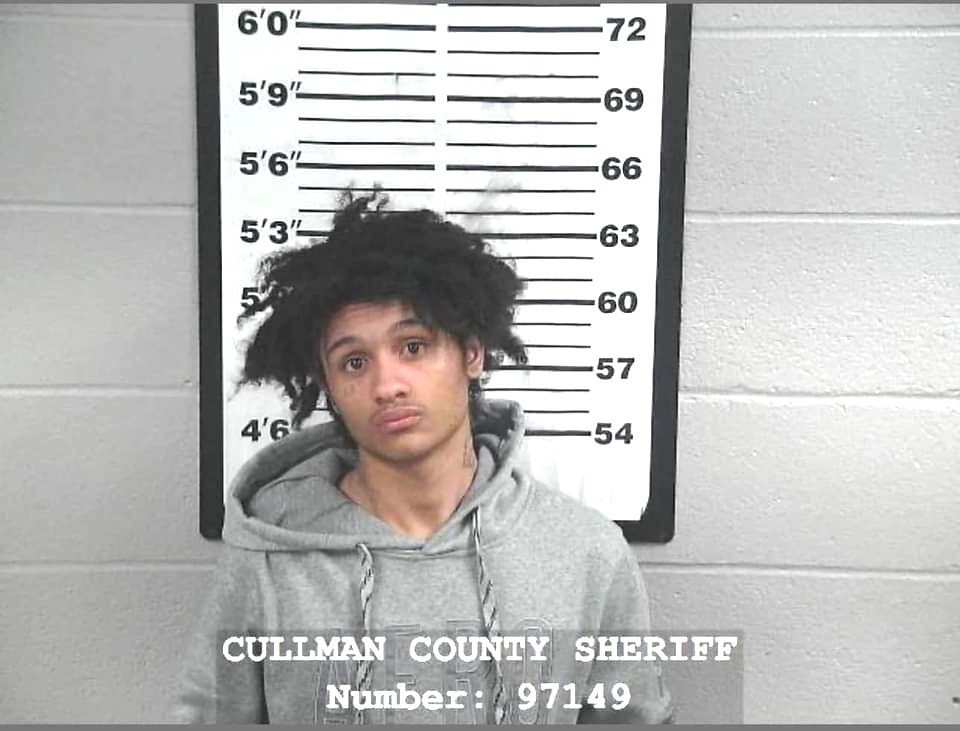
CULLMAN, Ala. – Cullman County Circuit Court Judge Emily N. Johnston denied Jamarion Allen Harrison’s request to dismiss his murder charge with prejudice Wednesday, Sept. 9, ruling the defense had not presented substantial evidence that prosecutors intended to provoke the mistrial she granted Sept. 1.
The four-page order permits the State to retry Harrison.
A little more than two hours after Johnston entered the ruling, Cullman County Assistant District Attorney Nathan A. Brock filed a motion asking the court to set the case for trial.
As of 2:18 p.m. Wednesday, Alacourt did not list a new trial date, and the State’s motion was marked active and pending.
Harrison is charged with murder in the July 2024 shooting death of Dylan Bomberry-Wright, 29. He is presumed innocent unless and until proven guilty.
“Accordingly, the Defendant’s Motion to Dismiss with Prejudice is DENIED,” Johnston wrote in the order entered at 11:13 a.m. Sept. 9.
Johnston did not withdraw or cast doubt on her earlier determination that a mistrial was warranted. She said the circumstances involving the defense witness identified in the filings as K.B. and Ms. Black were relevant to that decision.
The question presented by the later motion, however, was narrower: whether the State acted with the specific intent to cause Harrison to ask for a mistrial.
Under the U.S. Supreme Court’s 1982 decision in Oregon v. Kennedy, a defendant who requests and receives a mistrial ordinarily may be tried again.
Retrial is barred only when government conduct was intended to provoke the defendant into seeking the mistrial.
Johnston also cited the Alabama Supreme Court’s decision in Ex parte State, known as R.E.D., which requires substantial evidence capable of supporting a rational finding of that intent before the issue proceeds to a factual determination.
“The objective circumstances reflected in the record do not provide substantial evidence of that specific intent,” Johnston wrote.
The judge pointed to statements prosecutors made during the trial that they were ready and eager to move forward.
When the defense ultimately pressed its mistrial request after Black invoked her Fifth Amendment privilege, the State opposed the motion and asked that the trial continue.
Johnston said the State’s opposition did not decide the intent question by itself, but it was an objective circumstance relevant to the legal test.
Johnston also noted that the defense maintained its request after she asked whether anything short of a mistrial would allow Harrison to proceed.
Defense counsel represented that Black possessed direct, firsthand knowledge that no other witness could provide.
Considering the record as a whole, Johnston concluded the defense had not met the substantial-evidence threshold and that retrial was not barred.
The ruling also denied the defense’s alternative request for an evidentiary hearing into the State’s intent. Johnston found that the motion did not satisfy the threshold required for such a proceeding.
The defense separately argued that the circumstances deprived Harrison of his constitutional right to present a defense and independently required dismissal.
Johnston rejected that basis as well. She wrote that dismissal with prejudice is an extraordinary remedy and that the defense had not established that the disputed circumstances would prevent a fair retrial or that any resulting prejudice could not be addressed through a lesser remedy.
Johnston declined to order the disclosure sought by the defense of communications and other materials involving Black, finding that disclosure unnecessary to decide the motion.
She added that the order did not change any preservation or disclosure duty imposed by law, court rule or an earlier order.
The mistrial arose after the State rested its case and the defense prepared to call Black.
Court records show she had received youthful-offender treatment in a separate criminal case under an agreement requiring full, truthful and continuing cooperation.
During the Harrison trial, the State announced that it intended to ask the court in Black’s separate case to set aside or withdraw that adjudication based on an alleged failure to comply with the agreement.
Because Black potentially faced legal consequences from her testimony, Johnston appointed independent counsel to advise her.
Black then invoked her Fifth Amendment privilege and did not testify.
The defense said her firsthand knowledge was central to Harrison’s case and that no other witness could replace her.
Johnston granted Harrison’s request for a mistrial while reserving the question of whether another trial would be permitted.
Harrison’s attorneys filed the motion to dismiss with prejudice Sept. 3. The motion alleged the State deliberately interfered with a central defense witness and caused her to invoke her right against self-incrimination.
The defense alleged Black and her mother had been told she would face a murder charge if she testified. It asked Johnston to bar a second trial, hold an evidentiary hearing, require the preservation and disclosure of communications and make findings concerning prosecutorial misconduct.
Cullman County District Attorney Champ Crocker and Assistant District Attorneys Nathan A. Brock and Michael Burleson filed the State’s 32-page response Sept. 8.
They denied that prosecutors threatened or sought to silence Black.
The response characterized the State’s announcement as notice that it might seek judicial enforcement of her cooperation agreement in her own case, where Black would be represented and the State would bear the burden of proving any breach.
Prosecutors argued that the record contradicted any claim that they wanted the trial to end.
They said the State had promised Black’s testimony during opening statements, had presented a case that survived Harrison’s motion for a judgment of acquittal and opposed the mistrial.
The response also disputed the defense’s description of Black as a necessarily favorable witness, pointing to differing accounts of what she said she witnessed. Those arguments were the State’s position, not independent factual findings in Johnston’s Sept. 9 order.
The State asked Johnston not only to deny Harrison’s motion but also to expressly find that no prosecutorial misconduct occurred.
Johnston did not make that broader finding.
Her order instead resolved the legal questions before her: the defense did not present substantial evidence that the State specifically intended to provoke a mistrial and did not establish another basis for dismissing the indictment with prejudice.
She denied all other requested relief from both sides as unnecessary to that determination.
Harrison remains listed as jailed in Alacourt.
33ac9ac4-8716-4922-9007-d13ffa20cd78Judge_Johnston_Order_Denying_Dismissal_Sept_9_2026