








CULLMAN, Ala. – In the public campaign surrounding Vista Lago Smith Lake Development, the argument has often been reduced to two sharply different descriptions.
Opponents have warned that sewage will be pumped into Smith Lake.
Vista Lago has publicly stated that its Alabama Department of Environmental Management permit “does NOT” authorize a direct discharge into Smith Lake. The developer’s July 17 statement also says treated effluent will be released about one-third of a mile inland.
The records support parts of both arguments, but not their broadest formulations.
Two facts remain consistent throughout The Tribune’s review:
- The wastewater is required to be treated before discharge.
- ADEM considers the permit the first direct NPDES discharge to Lewis Smith Lake.
Much of the controversy lies in the broader claims surrounding those facts.
ADEM confirms the precedent claim
Eddie Hand formally raised the precedent question with ADEM during the permit’s public-comment period.
In an April 16 email, Hand asked whether Vista Lago would represent the first sewer-discharge permit in the Lewis Smith Lake drainage area and requested a list of existing permits if it was not.
Hand later asked ADEM to have the development redesign its wastewater system to conform with non-discharge systems he identified elsewhere around Smith Lake.
ADEM drew a distinction.
Vista Lago was not the first wastewater permit within the Smith Lake drainage area.
It was, ADEM said, the first NPDES permit to directly discharge to Lewis Smith Lake.
That is the central precedent established by the agency’s own response.
Permit authorizes treated wastewater, not raw sewage
Nothing reviewed by The Tribune authorizes Vista Lago to routinely discharge untreated sewage into Smith Lake.
The system has a 0.060-MGD, or 60,000-gallon-per-day, design flow. Its NPDES permit establishes limits for bacteria, suspended solids, biochemical oxygen demand, ammonia, chlorine, dissolved oxygen and other parameters.
The application reports one treated-effluent outfall and zero untreated-effluent outfalls.
That does not mean equipment cannot fail, an overflow cannot occur or permit limits cannot be violated. The permit contains requirements addressing sanitary sewer overflows, treatment failures, monitoring and enforcement.
A potential malfunction and the discharge ADEM affirmatively permits are different issues.
Describing the permit itself as authorization to dump raw sewage would be inaccurate.
Application lists outfall 100 feet from shore
Another figure cited by opponents appears in the permit application.
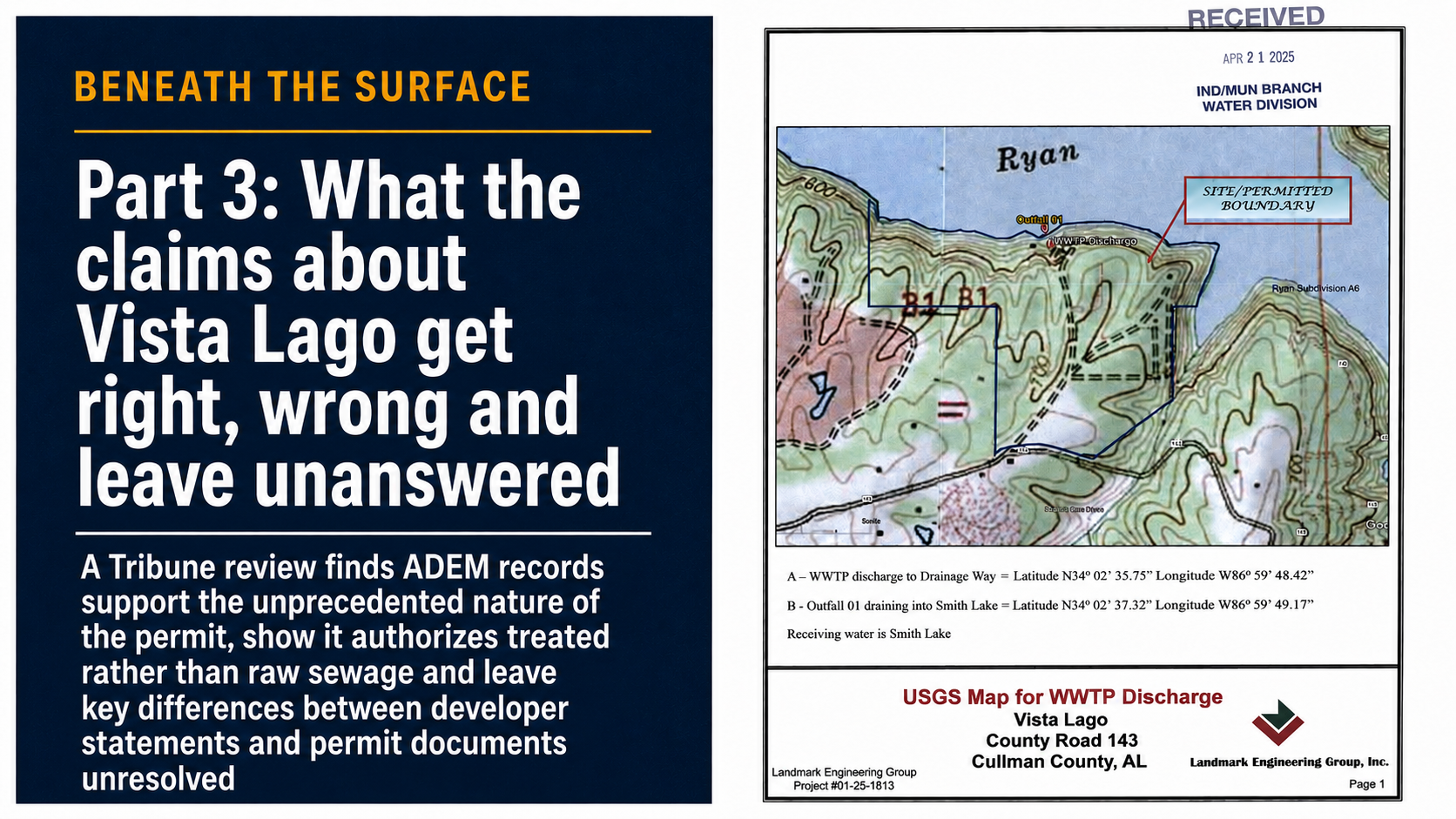
Vista Lago’s EPA Form 2A identifies Outfall 1 as 100 feet from shore, lists the depth below surface as 0 feet and gives a 0.060-MGD average daily flow designation. The discharge is characterized as continuous rather than seasonal.
Landmark Engineering Group’s map identifies a wastewater-treatment-plant discharge to a drainage way and a second point labeled “Outfall 01 draining into Smith Lake.”
The map states, “Receiving water is Smith Lake.”
Those records create an unresolved difference between the permit file and Vista Lago’s public explanation.
In its July 17 statement, Vista Lago said its permit does not authorize direct discharge into Smith Lake. It said treated effluent would be discharged into an approximately 30-acre wooded parcel about one-third of a mile inland from the lake.
ADEM uses different terminology.
Its response to public comments calls Vista Lago the first NPDES permit to directly discharge to Lewis Smith Lake.
One possible explanation is a regulatory distinction between the physical location where treated effluent leaves the treatment system and the receiving water assigned to the permitted outfall.
The record reviewed by The Tribune does not establish that explanation clearly enough to reconcile the two descriptions.
That remains a question for ADEM and the project engineer.
Permit materials describe a multi-stage treatment system
Vista Lago’s public statement emphasizes the level of treatment proposed for the development.
Landmark Engineering submitted the project to ADEM as a decentralized extended-aeration wastewater treatment plant.
Engineering drawings depict multiple treatment stages, including:
- Flow equalization
- Aeration
- Anoxic zones
- Clarification
- Chlorination
- Phosphorus treatment
Vista Lago publicly describes the system as a commercial STEP septic system and a scaled version of a municipal wastewater treatment plant.
Those descriptions are not necessarily inconsistent because a treatment system can contain multiple collection and treatment components.
For purposes of the NPDES permit, ADEM describes the facility as discharging treated domestic wastewater to Ryan Creek (Smith Lake).
Permit file does not substantiate “5X cleaner” claim
Vista Lago’s July statement says effluent standards for the system will be “5X cleaner than required by ADEM.”
The permit reviewed by The Tribune does not contain a single measurement called “cleanliness.” Wastewater is regulated through individual parameters.
ADEM sets limits for E. coli, CBOD, ammonia, suspended solids and residual chlorine and establishes monitoring requirements for nitrogen- and phosphorus-related parameters.
The application contains projected removal percentages, but The Tribune found no calculation in the permit file demonstrating a blanket fivefold comparison between Vista Lago’s anticipated effluent and ADEM’s required limits.
That does not establish the developer’s claim is false.
It means the claim cannot be independently verified from the permit documents reviewed.
A pollutant-by-pollutant comparison identifying expected effluent concentrations and corresponding regulatory limits would allow the claim to be evaluated.
The same standard applies to comparisons between the proposed plant and conventional septic systems. Whether one system presents less environmental risk depends on engineering, soil, hydrogeology, operation and maintenance, among other factors.
Developer describes additional wooded bioretention area
Vista Lago says treated effluent will enter an engineered bioretention area with vegetation intended to absorb surface water not absorbed by the surrounding wooded area.
The developer describes that measure as outside ADEM’s required scope.
The operative ADEM materials reviewed by The Tribune identify the permitted receiving pathway as a local drainage way to Smith Lake and identify Outfall 01 draining into Smith Lake.
The documents reviewed do not establish the approximately 30-acre wooded parcel or broader bioretention description as an enforceable condition of NPDES Permit AL0084516.
That distinction is significant because a voluntary project feature and a permit requirement are not necessarily the same thing.
Final engineering plans may provide additional clarity. The permit requires plans and specifications to be submitted to and examined by ADEM before construction of the wastewater treatment facility.
Permit records address sludge and SSO planning
The permit file addresses two additional points raised in public criticism.
Sludge:
- The application estimates approximately 1.5 dry metric tons annually.
- Dewatering is identified as part of the process.
- Landfill disposal is selected.
- The final landfill was not identified in the material reviewed by The Tribune, leaving the destination unresolved.
Sanitary Sewer Overflow Response Plan:
- Maverick must develop the plan within 120 days of the June 1 permit effective date.
- The plan must be fully implemented within 180 days.
- Once completed, it must be made available to the public within 30 days of a written request, subject to limited security-related redactions.
The absence of a completed plan immediately after permit issuance therefore does not establish a missed permit deadline.
303(d) listing is for mercury
Opponents have correctly pointed out that the portion of Ryan Creek (Smith Lake) containing the discharge is on Alabama’s 303(d) impaired-waters list.
The pollutant identified in the permit file is mercury.
ADEM requires annual mercury monitoring so information will be available for future total maximum daily load development. The agency says no existing TMDL affects the Vista Lago discharge.
The listing is relevant environmental context.
It is not evidence that Vista Lago caused the existing impairment, nor does the permit identify the segment as impaired because of Vista Lago wastewater, nitrogen, phosphorus or E. coli.
No recognized “third cleanest” ranking located
Hand told ADEM that Smith Lake “builds itself as the cleanest lake in Alabama,” and public material reviewed by The Tribune has repeated variations of claims that Smith Lake ranks among the cleanest lakes in the country.
The Tribune has not located a recognized state or federal ranking system supporting a specific national placement such as “third cleanest lake in America.”
The claim is unnecessary to establish the regulatory precedent.
ADEM’s own response provides the narrower, documented point: no NPDES permit previously identified by the agency directly discharged to Lewis Smith Lake.
ADEM says it lacks authority to require a non-discharge design
The public campaign has repeatedly called for Vista Lago to use a non-discharge alternative.
Hand made essentially that request directly to ADEM.
The agency declined.
ADEM said the permit was developed according to applicable regulations, water-quality standards and technology-based requirements. It also said it does not have regulatory authority to require a particular treatment-system design or a non-discharge system.
That does not prevent the developer from voluntarily choosing another system.
That distinction is central to Rep. Cindy Myrex’s position.
Myrex calls for voluntary alternative
Myrex has not publicly characterized the permit as illegal or presented herself as an environmental specialist.
Instead, she has framed her position around finding another solution.
In one statement reviewed by The Tribune, Myrex said she had “appealed on multiple levels for the developers to consider an alternative option.”
She said she is not an environmental specialist and has listened to constituents, stakeholders and experts as the issue developed. She also said discussions involving the Smith Lake community and the developers were taking place and that she had offered to participate.
In a more recent statement, Myrex said she remained focused on a resolution addressing residents’ concerns “while giving the developer an opportunity to pursue a responsible alternative.”
That position is separate from ADEM’s regulatory decision.
ADEM has determined that the discharge can be permitted under the conditions imposed.
Myrex is asking the developer to consider another option despite that authorization.
Permit allows future ADEM action if standards are violated
Vista Lago has an effective NPDES permit.
ADEM states that compliance with its terms and conditions should assure compliance with applicable water-quality standards.
The permit also provides for future action if circumstances prove otherwise.
If the discharge causes or contributes to a violation of state water-quality standards, ADEM may require abatement, modify the permit or, in an emergency, prohibit the discharge until the permit is modified.
ADEM has also acknowledged that no Smith Lake-specific water-quality model currently exists. Its Water Quality Branch relied on best professional judgment in establishing initial limits, and the permit rationale says a future Smith Lake model could be used to determine whether those limits should be revised.
What the record establishes, and what remains unresolved
After reviewing permitting documents, public comments, maps, public statements and wastewater records, The Tribune’s findings are narrower than many of the arguments circulating around Smith Lake.
The record establishes:
- Vista Lago has not been permitted to routinely discharge raw sewage into the lake.
- ADEM identifies the permit as the first NPDES permit to directly discharge treated wastewater to Lewis Smith Lake.
- Existing wastewater plants operate within the lake’s drainage area, but ADEM says none directly discharge into the lake.
- Vista Lago’s permit contains enforceable treatment and monitoring requirements.
- The permit addresses sludge and sanitary sewer overflow planning, although the eventual sludge destination remains unresolved.
Other questions remain:
- The permit application lists the outfall as 100 feet from shore while Vista Lago says treated effluent will be discharged about one-third of a mile inland.
- ADEM calls the permit the first NPDES permit to directly discharge to Lewis Smith Lake while Vista Lago says the permit does not authorize direct discharge into Smith Lake.
- Vista Lago says its effluent standards will be five times cleaner than ADEM requires, while the permit file reviewed by The Tribune does not provide the pollutant-by-pollutant calculation needed to independently verify that statement.
- The permit materials reviewed do not establish the approximately 30-acre wooded parcel or broader bioretention system as an enforceable condition of the NPDES permit.
- ADEM issued the permit without a completed Smith Lake water-quality model, relying on best professional judgment while leaving open the possibility that future modeling could result in revised limits.
None of those unresolved questions establishes that the permitted system will harm Smith Lake.
The issuance of the permit also does not, by itself, answer them.
For the first NPDES permit ADEM says will directly discharge to Lewis Smith Lake, the remaining issues are measurable: the exact relationship between the physical discharge point and permitted outfall, pollutant-specific performance data, the status of the proposed bioretention area in final plans and how future Smith Lake modeling could affect permit limits.
Those are the questions the public record now leaves to be answered.