Federal lawsuit claims Sheriff Matt Gentry falsely said he had a warrant before deputy’s phone was searched; filing also alleges retaliation and unpaid overtime
Updated Aug. 14, 2026, to include responses from Cullman County Sheriff Matt Gentry and Cullman County District Attorney Champ Crocker and information concerning Gentry’s legal representation
CULLMAN, Ala. – A former Cullman County detention deputy has filed a federal lawsuit alleging Sheriff Matt Gentry and Capt. Phillip Harris illegally seized and searched his personal cellphone after he reported a cybersecurity vulnerability affecting a law enforcement information system.
Gentry has since called the lawsuit “frivolous” and said the sheriff’s office acted in accordance with the law.
Payton Rohrscheib filed the complaint April 29 in U.S. District Court for the Northern District of Alabama. The lawsuit names Gentry, Harris, Capt. Rex Sorrow, Capt. Todd Reynolds, Lt. Rebekah Cash and Cullman County as defendants.
The case, Rohrscheib v. Gentry et al., has been assigned case number 5:26-cv-00718-HDM and is before U.S. Magistrate Judge Harold D. Mooty III.
Rohrscheib is represented by Scott Morro of Morro Law Center in Gardendale. Morro told AL.com Aug. 12 that he planned to amend the complaint to remove Sorrow, Reynolds and Cash, leaving Gentry, Harris and Cullman County as defendants.
A free public docket index reviewed by The Tribune on Friday still reflected the original six-defendant complaint and had not been updated since May 13. The index did not show an amended complaint.
Although Sorrow, Reynolds and Cash appear in the original complaint’s caption and factual allegations, none of its eight legal counts is expressly directed against them.
The lawsuit contains Rohrscheib’s allegations and represents one side of the dispute. The allegations have not been proven, and the court has not ruled that any defendant violated Rohrscheib’s rights.
Gentry responds
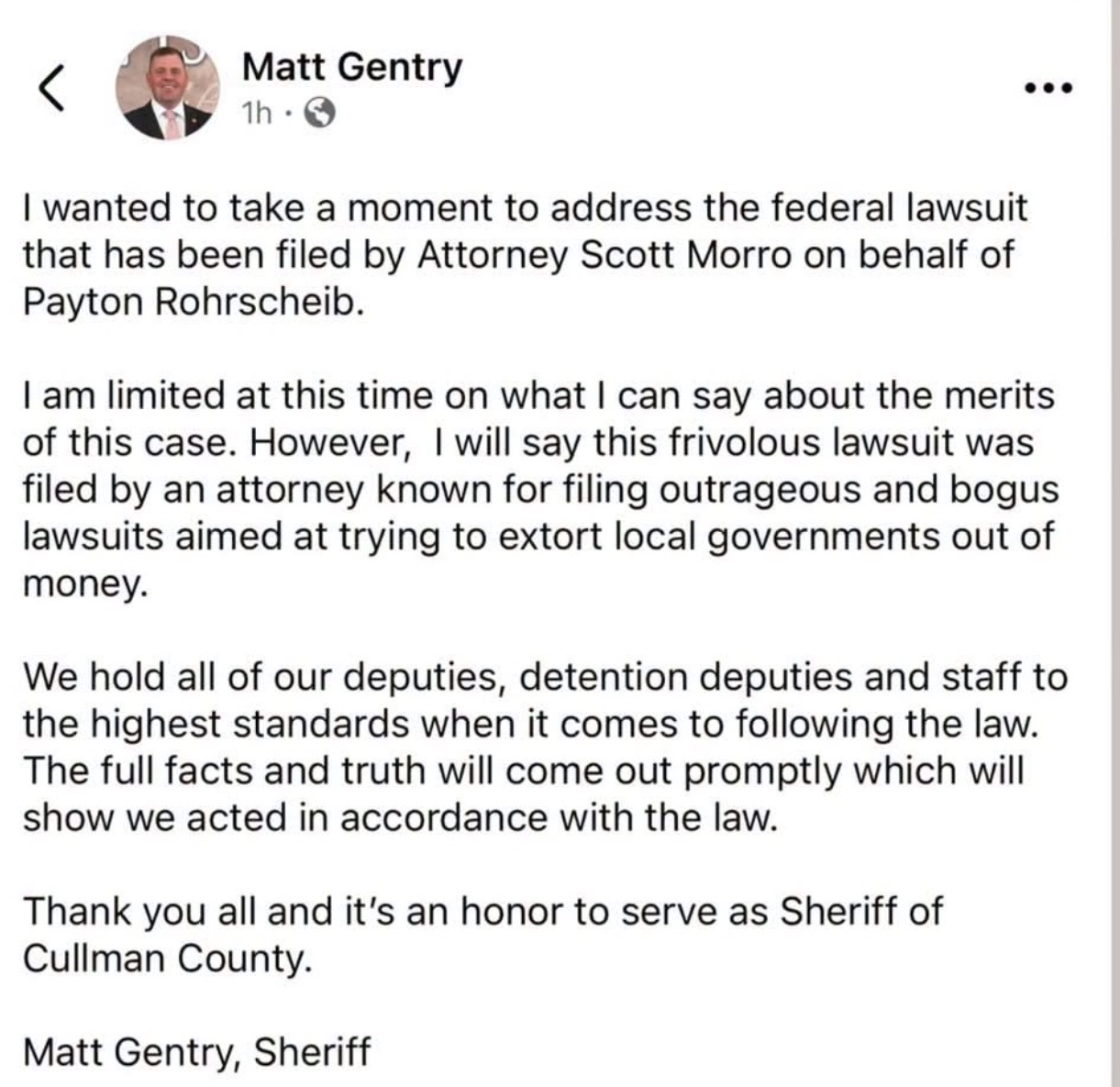
In a statement posted on his personal Facebook page Wednesday after reports began, Gentry said he was limited in what he could say about the case but disputed the lawsuit and criticized Morro.
“I am limited at this time on what I can say about the merits of this case. However, I will say this frivolous lawsuit was filed by an attorney known for filing outrageous and bogus lawsuits aimed at trying to extort local governments out of money,” Gentry said.
“We hold all of our deputies, detention deputies and staff to the highest standards when it comes to following the law. The full facts and truth will come out promptly which will show we acted in accordance with the law,” Gentry said.
Gentry’s statement did not address the complaint’s specific allegations concerning the timing of the search warrant, the initial search of Rohrscheib’s cellphone, the compelled disclosure of the passcode, the later forensic extraction or the unpaid overtime claim.
Gentry’s description of the lawsuit as frivolous represents his position. Nothing in the publicly available docket reviewed by The Tribune reflects a court ruling on the merits or a judicial determination that the lawsuit is frivolous.
DA declines comment; county attorney not representing Gentry
The Tribune also sought comment from Cullman County District Attorney Champ Crocker.
“I have a policy of not commenting on matters under investigation. Therefore, I have no further response at this time,” Crocker said.
Crocker did not specify which matter he described as being under investigation or provide additional details.
The Tribune also confirmed Friday that Cullman County Attorney Bradley Wilson is not representing Gentry in the federal lawsuit. The confirmation concerns Gentry only and does not establish who will represent Harris, Cullman County or the other defendants.
Reported cybersecurity vulnerability
Rohrscheib worked for the Cullman County Sheriff’s Office for approximately five years as a detention deputy, according to the complaint.
The filing says he was not certified by the Alabama Peace Officers’ Standards and Training Commission, had no arrest authority outside the jail and held no policymaking or supervisory authority.
On or about Jan. 23, Rohrscheib allegedly discovered a vulnerability while helping another deputy access the CJIS/ALACOP certification portal.
According to the complaint, accessing the portal through a Google Chrome browser history caused the system to authenticate the user under the credentials of the employee who had most recently logged in. Rohrscheib claims the process bypassed the normal username, password and two-factor authentication requirements.
The filing alleges that anyone with access to the browser history on a sheriff’s office computer could potentially enter another employee’s account without providing credentials.
Rohrscheib says he verbally reported the issue to a shift supervisor in January but saw no indication that additional action had been taken.
On March 26, Rohrscheib completed an NCIC recertification test that he says instructed certified employees to report security breaches and suspicious activity.
At approximately 7:30 a.m. March 27, Rohrscheib sent an email from his sheriff’s office account to an Alabama Law Enforcement Agency CJIS address describing the vulnerability. The complaint says he copied Charlie Gibbs, a sheriff’s office IT employee, on the email.
Rohrscheib alleges he received a telephone call from Reynolds approximately 50 minutes later directing him to report immediately to the sheriff’s office because of the email.
Alleged warrant claim and phone search
According to the complaint, Rohrscheib activated the audio recorder on his personal cellphone before entering Gentry’s office.
The meeting allegedly included Gentry, Harris, Reynolds, Cash and Timothy Kerber.
The filing says Gentry accused Rohrscheib of “backdooring” CJIS for personal gain and questioned what other systems he might have accessed. Rohrscheib says he denied accessing any system without authorization and explained that his email was intended as a cybersecurity report.
The lawsuit alleges Gentry then told Rohrscheib that he had a search warrant for Rohrscheib’s personal cellphone and that Rohrscheib was required to surrender the device and provide its passcode.
No warrant had been issued at that time, according to the complaint.
Rohrscheib alleges he disclosed the passcode and surrendered the phone because he believed he was legally required to comply and would be terminated if he refused.
The complaint says Harris entered the passcode and searched the phone for approximately five to 10 minutes.
Rohrscheib claims the device contained three recordings of meetings with sheriff’s office supervisors, including the March 27 meeting and an earlier meeting concerning a workplace complaint.
Gentry then suspended Rohrscheib pending an investigation, according to the lawsuit.
The filing says Rohrscheib’s mother, Cindy Rohrscheib, contacted the Cullman County Courthouse and
Cullman County District Attorney’s Office and confirmed that no warrant had been issued.
Rohrscheib and his mother allegedly returned to the sheriff’s office later that day. The complaint says Gentry acknowledged that he did not have a warrant but said he intended to seek one and was retaining the phone under “exigent circumstances.”
Search warrant obtained three days later
The complaint says Harris submitted an application and affidavit for a search warrant March 30, three days after the phone was seized.
The application was filed under Cullman County case number 260303385 and sought authority to search a red Samsung cellphone for evidence of computer tampering under Alabama law.
Rohrscheib alleges the affidavit falsely stated that he declined to report the vulnerability to a supervisor or the IT department and wanted to fix it himself.
The complaint argues that the statement was contradicted by Rohrscheib’s reported January conversation with his supervisor and the March 27 email copying Gibbs.
The lawsuit also alleges Harris incorrectly claimed Rohrscheib had breached a computer system. Rohrscheib maintains that he discovered and reported an existing vulnerability rather than gaining unauthorized access.
According to the complaint, the warrant’s issuance fields did not contain a date or time. Rohrscheib also claims he was never given a copy of the warrant, although the return indicated that a copy had been provided.
The lawsuit says Harris conducted a full forensic extraction, described on the return and inventory as a “phone dump,” at approximately 1 p.m. April 6. The return was filed with the Cullman County court April 7.
Rohrscheib argues that the warrant did not identify the particular files, messages or categories of digital information officers were permitted to search.
The state search-warrant application, supporting affidavit, warrant and return were not attached as exhibits to the federal complaint. The Tribune has not independently reviewed those documents and is seeking copies from the Cullman County court file.
Retaliation allegations
In addition to his claims concerning the phone, Rohrscheib alleges Gentry retaliated against him for reporting the vulnerability and because members of Rohrscheib’s family supported Tim Creel in the Cullman County sheriff’s race this year.
The lawsuit alleges sheriff’s office employees were threatened with termination if they publicly supported a candidate opposed by Gentry. The complaint does not include supporting emails, messages or other exhibits documenting those alleged threats.
Rohrscheib claims the sheriff’s office changed the password to his work email account, collected his uniforms and issued equipment and directed other employees not to communicate with him.
The complaint also alleges the sheriff’s office stopped providing police reports and daily arrest and inmate lists to the state probation office where Rohrscheib’s mother worked. The lawsuit characterizes that action as retaliation against the family.
Rohrscheib accepted a position with the Morgan County Sheriff’s Office and resigned from the Cullman County Sheriff’s Office effective April 23, according to the filing. He contends the circumstances amounted to a constructive discharge.
Claims and requested relief
The complaint contains eight counts.
Three counts allege violations of the Fourth Amendment arising from the initial seizure of the phone, Harris’ alleged search of its contents and the later forensic extraction.
A fourth count alleges Gentry and Harris violated Rohrscheib’s Fifth Amendment protection against compelled self-incrimination by requiring him to disclose the passcode.
Two First Amendment counts accuse Gentry of retaliating against Rohrscheib for reporting the vulnerability and because of his family’s political activities.
The final two counts allege municipal liability against Cullman County and unpaid overtime under the Fair Labor Standards Act.
The filing says Rohrscheib earned $17.66 per hour and was not paid for work performed March 7, March 23 and March 24. The three periods listed in the complaint total approximately nine hours. A later paragraph, however, describes the total as approximately 4.25 hours.
The complaint contains other apparent drafting errors, including inconsistent pronouns, duplicate paragraph numbers and bracketed notes directing counsel to confirm or develop portions of the case through discovery.
Rohrscheib is seeking compensatory and punitive damages in amounts to be determined at trial. He also asks the court to order the return of his phone, require the destruction of forensic copies and extracted data, award unpaid overtime and legal fees and prohibit additional retaliation.
He has demanded a jury trial.
The Tribune will update this report as additional responses, federal filings and state court records become available.