CULLMAN, Ala. – The Cullman County Sheriff’s Office operates its own Flock Safety automated license plate reader system, maintains a written policy for its use and produced audit records showing searches across local and outside networks.
This is Part 3 of The Cullman Tribune’s series examining Flock Safety automated license plate reader cameras in the Cullman area. Part 1 focused on the Cullman Police Department. Part 2 focused on Hanceville’s Flock cameras, the city’s police department dissolution and Wallace State Community College.
This article focuses on CCSO’s Flock contract, policy, audit records, shared-network document and the four former Hanceville cameras authorized for transfer to CCSO after Hanceville dissolved its police department.
Source materials for this article include:
- A Flock Safety order form
- Camera location and installation records
- A shared networks document
- An audit log
- A system-use acknowledgment
- CCSO policy documents
- Hanceville transfer records
- A Flock amendment adding four cameras to the CCSO agreement
The Tribune is not publishing a full map of camera locations or camera angles.
CCSO Flock agreement
CCSO’s Flock Safety order form identifies the customer as “AL – Cullman County SO.”
The order form lists:
- A 24-month initial term
- A 24-month renewal term
- A 30-day retention period
- Nine Flock Safety Falcon cameras
- One Flock Safety Falcon Flex
- A $31,850 first-year subtotal
- A $30,500 annual recurring subtotal
- A $62,350 contract total
- The sheriff’s office address as 1910 Beech Ave. SE in Cullman
County records also included a location list and map, installation dates, a shared networks file, an audit log and a system-use acknowledgment.
The location and installation records identify fixed camera locations and show installation dates in 2024 and 2025. They also identify a flex camera and two bundle entries.
CCSO policy
CCSO’s license plate reader policy, General Order 34, became effective Jan. 14, 2025.
The policy says the purpose of the LPR system is to deter criminal behavior and, in certain circumstances, use recorded footage or photos in the investigation and prosecution of criminal activity.
It also says CCSO seeks to ensure its use of LPR technology conforms to constitutional principles and balances public safety with residents’ rights, including:
- Privacy and anonymity
- Freedom of speech and association
- Government accountability
- Equal protection
The policy also recognizes it is in the best interest of citizens for CCSO to cooperate with homeowner associations, businesses and others operating LPR systems in Cullman County.
Under General Order 34:
- Fixed LPR is described as a passive system.
- Live data is not viewed.
- Fixed LPR systems monitor all license plates that come in contact with the camera.
- Historical data searches may be done only by staff with access.
- Searches must be for legitimate public safety-related purposes.
- A log of requests must be maintained by the system.
- LPR data is for official use only.
- Data may be shared only for legitimate law enforcement purposes.
- Data disseminated outside the agency should be documented in a secondary dissemination log.
- Outside law enforcement agencies may request specific queries of the LPR database for legitimate law enforcement purposes.
- Only matching returns will be shared with the requesting agency.
- Sharing the LPR database with outside law enforcement or other government agencies is prohibited except to the degree required by law.
- Sharing LPR data with third parties, including private litigants, is prohibited except to the degree required by law.
The county policy says LPR-related photos and data will be stored for a maximum of 30 days.
If LPR data is deemed evidence in a police-related case, it will be transferred to and retained in the agency’s digital evidence storage system.
System-use acknowledgment
The county system-use acknowledgment states users are accessing a restricted information system for authorized use only.
The acknowledgment says users must comply with Flock’s Privacy Policy and CJIS Security Policy.
It also states users consent to be monitored, recorded and audited by Flock and their agency.
The acknowledgment warns that unauthorized or improper use may lead to disciplinary action and criminal or civil legal penalties.
Shared networks document
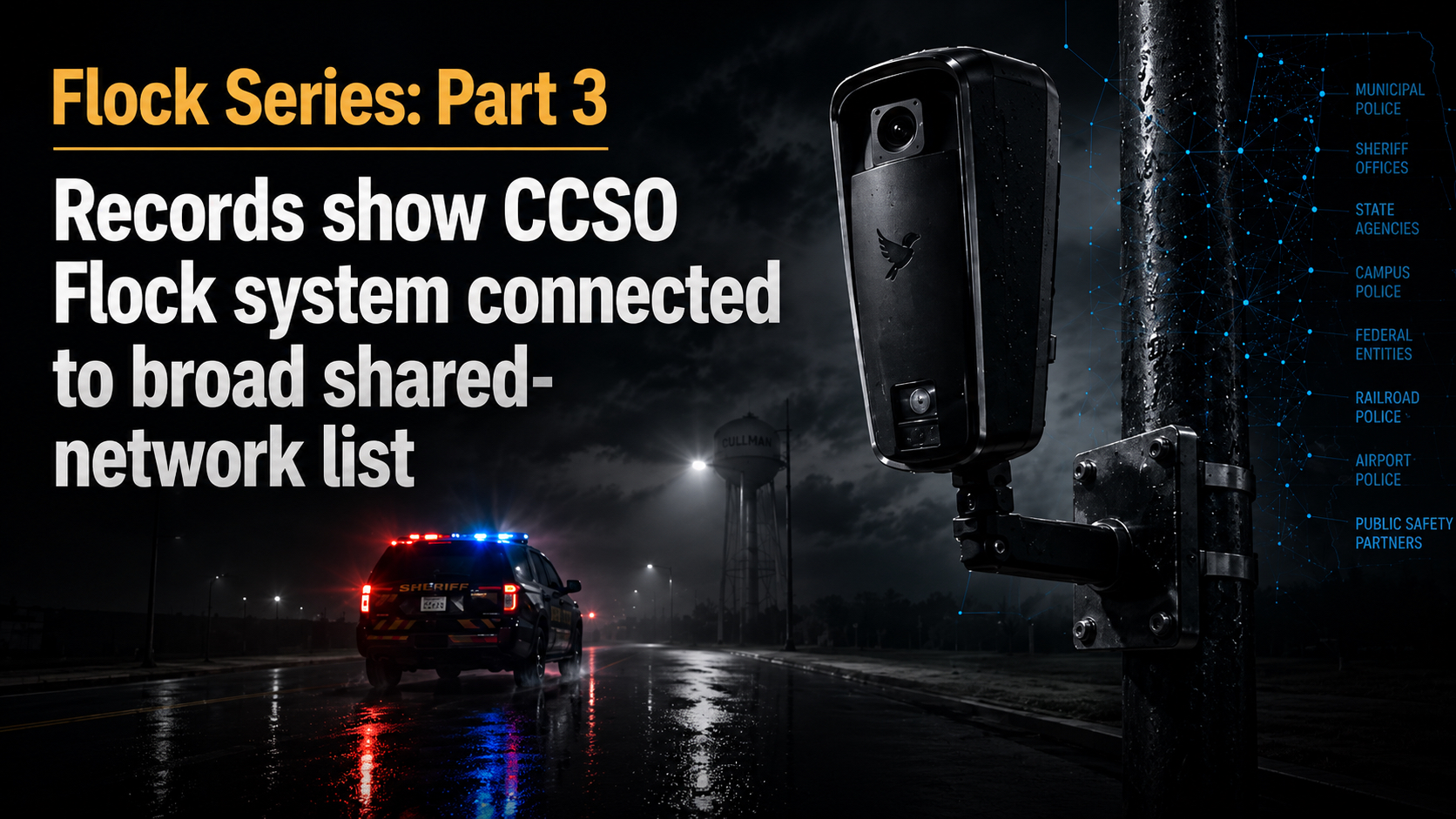
CCSO produced a 62-page shared networks document listing law enforcement, public safety and related agencies across Alabama and other states.
The list includes:
- Municipal police departments
- Sheriff’s offices
- Campus police departments
- Airport police
- State agencies
- Federal entities
- Railroad police
- Other public safety organizations
The county document is not the same type of record as the City of Cullman’s sharing spreadsheet.
The city spreadsheet identified organizations, networks shared with CPD and networks CPD was sharing. The county document lists organization names but does not clearly state each listed agency’s access level.
It also does not clearly state whether each sharing relationship is one-way, reciprocal or limited by request.
For that reason, The Tribune is not characterizing every agency in the county document as having the same kind of access.
The record does show CCSO’s Flock system is connected to a shared law enforcement network beyond Cullman County.
Audit log
The county audit log is a 28-page document covering activity from April 11 through May 11, 2026.
It lists:
- User names
- Organization name
- Total networks searched
- Time frames
- Reasons
- Search times
- Search types
The reasons visible in the audit log included:
- Larceny/theft
- Motor vehicle theft
- Stolen property
- Drugs/narcotics
- Missing or endangered person/runaway
- Wanted person
- DUI
- Sex offenses
- Financial crime
- Robbery
- Threats/harassment
Some county entries listed hundreds or thousands of networks searched. Several entries listed more than 2,000 networks searched. Some listed more than 6,000.
The audit records do not, by themselves, show that those searches were improper.
They do show the scale of the searchable network available through the system and the importance of written access rules, user logs and agency review.
The audit records do not show the outcome of each search. They do not show whether each search led to an arrest, a recovered vehicle, a warning, no enforcement action or another result.
Hanceville camera transfer
Hanceville’s four-camera Flock system became part of CCSO’s records after Hanceville dissolved its police department earlier this year.
Ordinance No. 2026-2, adopted by the Hanceville City Council on Feb. 12, 2026, abolished the Hanceville Police Department, eliminated all positions within the department and shifted law enforcement authority to CCSO.
CCSO’s authority within Hanceville’s corporate limits and police jurisdiction includes:
- Patrol
- Investigation
- Arrest authority
- Response to calls for service
Hanceville had four Flock cameras at or near the Alabama Highway 91 and U.S. Highway 31 intersection.
A March 24 text message screenshot shows a Hanceville official telling Gentry the city understood CCSO could still access data from the cameras, even though Hanceville no longer could.
The message said there was a monthly cost of approximately $850 and asked whether the sheriff’s office would be willing to pay some or all of that cost until Hanceville got a police department back.
“I hate to have them disconnected if they have value,” the message said.
Gentry responded that he believed the State of Alabama could access the cameras and asked how many cameras Hanceville had. The answer was four.
A later message attributed to IT said the cameras appeared to be the Hanceville cameras. The message said CCSO could access them but did not have control over them.
The same message said CCSO could absorb the cameras with:
- A copy of the police department dissolution
- A letter from Hanceville’s mayor authorizing the transfer
On April 1, Mayor Nolan Bradford signed a letter to Gentry authorizing the transfer of the four Flock cameras at the 91/31 intersection from the City of Hanceville to CCSO.
The letter said Hanceville would pay all Alabama Power invoices through March 31.
An email from Bradford to Gentry that same morning said the letter and the signed police department dissolution ordinance were attached.
A separate Flock Safety amendment dated April 17, 2026, amended the agreement between Flock and AL – Cullman County SO.
The amendment listed:
- Four Flock Safety LPR fixed Falcon cameras
- A $12,000 annual recurring subtotal
- An amendment to the CCSO agreement
The materials show Hanceville authorized transfer of the cameras and CCSO’s Flock agreement was amended to add four fixed Falcon cameras.
They do not include a separate final confirmation from Flock stating the exact date the transfer was completed inside the system.
What the records show
The records show:
- CCSO purchased its own Flock Safety system with nine Falcon cameras and one Falcon Flex.
- The county order form listed a 30-day retention period.
- CCSO adopted General Order 34, a written license plate reader policy effective Jan. 14, 2025.
- The county policy limits LPR data to official use and legitimate law enforcement purposes.
- LPR-related photos and data are stored for a maximum of 30 days unless deemed evidence in a police-related case.
- CCSO produced a 62-page shared networks document listing agencies across Alabama and other states.
- CCSO produced an audit log covering April 11 through May 11, 2026.
- Some searches listed hundreds or thousands of networks searched.
- Hanceville authorized the transfer of four Flock cameras to CCSO after dissolving its police department.
- A later Flock amendment added four fixed Falcon cameras to the CCSO agreement.
What the records do not show
The records do not show:
- A complete outcome report showing how many arrests, convictions, stolen vehicle recoveries or missing person recoveries were directly tied to CCSO’s Flock system
- The outcome of each audit-log search
- Each agency’s access level in the county’s 62-page shared networks document
- Whether each listed shared-network relationship is one-way, reciprocal or limited by request
- A separate final confirmation from Flock stating the exact date the Hanceville camera transfer was completed inside the system
- Whether Hanceville retained any access after the transfer authorization
- A Hanceville-specific audit log from before the department was dissolved
- Whether any CCSO user or outside user was disciplined for improper access
- A public annual report listing CCSO Flock usage, case outcomes, audits or misuse findings
Series conclusion
Flock Safety automated license plate reader systems are now part of law enforcement operations in the Cullman area.
The documents show the Cullman Police Department, Hanceville and the Cullman County Sheriff’s Office each had records tied to Flock systems, access or camera transfers.
They also show differences in policy, retention language, sharing records and the level of detail released by each agency.
The Tribune is not asserting that each withheld record must be public.
The records show that camera ownership, network access, retention rules, audit records and public reporting can vary by agency.
They also show local Flock systems are not isolated from broader law enforcement networks.
The series leaves several questions for agencies to answer, including:
- How often ALPR searches are reviewed
- How access is approved
- How misuse is handled
- How outcome data is tracked
- What information can be released publicly without compromising active investigations or camera security
Read part 1 at www.cullmantribune.com/2026/07/07/records-show-cullman-police-departments-flock-camera-system-expanded-as-retention-policy-changed.
Read part 2 at www.cullmantribune.com/2026/07/09/records-show-hanceville-flock-cameras-authorized-for-transfer-after-police-department-dissolution.