



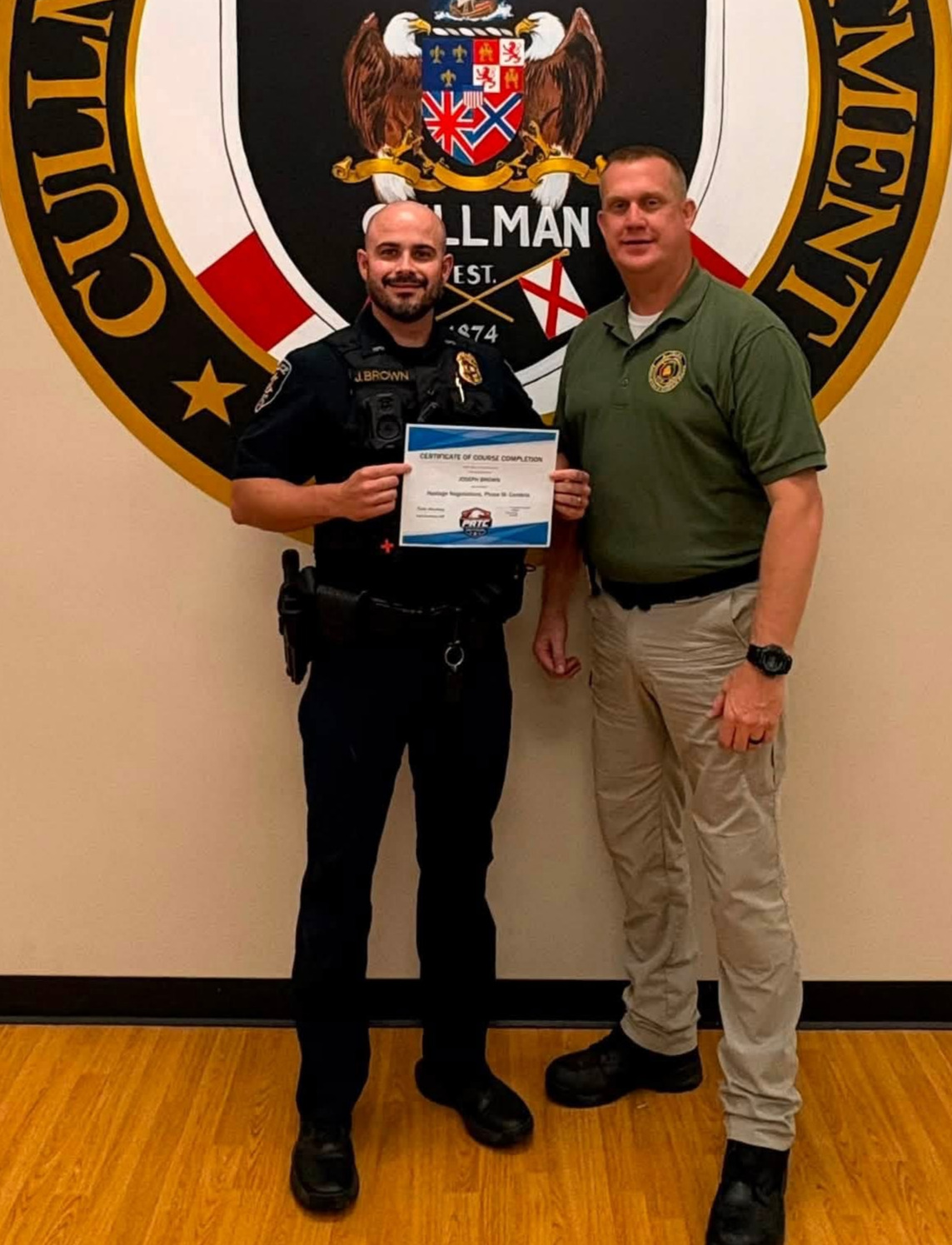
CULLMAN, Ala. – Cullman Police Officer Daniel Brown has completed the final phase of an intensive hostage and crisis negotiation training program, giving the department another advanced resource for resolving some of the most volatile situations officers can encounter without the use of force.
Brown completed the 40-hour Hostage Negotiations, Phase III course through the Public Agency Training Council in Alabama Aug. 3-7. The course was taught by retired New York City Police Department hostage negotiator Jack Cambria.
The Cullman Police Department said completion of the third phase gives Brown full certification as an Advanced Primary Negotiator.
The designation represents considerably more than attendance at a single training course.
PATC requires negotiators seeking its certification to complete all three phases of its hostage negotiation curriculum. Phase III is available only to officers who previously completed PATC’s Phase I and II training.
Brown completed Phase I and II earlier this year in training hosted by the Hoover Police Department and also taught by Cambria, according to CPD.
At the conclusion of Phase III, participants face a 50-question examination covering material from all three phases and must score at least 75% to receive certification.
Each participant is also evaluated on his or her ability to perform the responsibilities of a primary negotiator. PATC’s hostage negotiation certification is valid for two years before recertification is required.
What the training covers
Phase III moves beyond the fundamentals of establishing communication with a person in crisis.
PATC says the advanced curriculum covers management of hostage negotiation teams and scenes, evaluating hostage and barricade situations, suicidal-risk analysis, negotiations involving people experiencing mental illness, managing threatening situations, psychological threat assessment, stress and anxiety management and communication involving people affected by post-traumatic stress disorder.
The earlier phases include active listening, rapport building, crisis communication, management of demands, stress management and coordination among negotiators, tactical teams and incident commanders.
Participants also work through practical and scenario-based exercises designed to simulate actual crisis negotiations.
For residents, that distinction matters.
Hostage negotiation training is not limited to the movie-style scenario of someone holding another person at gunpoint.
Negotiators may be called during barricaded-subject incidents, suicidal crises, encounters involving people experiencing severe emotional or psychological distress and other situations in which establishing communication can help officers create time, gather information and work toward a safer resolution.
Having an officer trained and tested to perform the primary-negotiator role gives CPD an additional tool when a situation has reached the point where ordinary communication between a patrol officer and a person in crisis may no longer be sufficient.
It does not guarantee that every critical incident can be resolved peacefully. Rather, it gives the department specialized capability to attempt de-escalation and negotiation while commanders and tactical personnel manage the overall safety of the scene.
“This specialized training prepares officers to respond to some of the most challenging and high-pressure situations in law enforcement,” CPD Chief Joey Duncan said. “It builds advanced skills in communication, crisis intervention, de-escalation, active listening and developing strategies to safely resolve critical incidents while protecting lives.”
Nearly four years with CPD
Brown has served with the Cullman Police Department for nearly four years.
Archived department records show Brown was among three new officer candidates sworn in by Mayor Woody Jacobs on Sept. 26, 2022.
Since then, Brown has worked patrol assignments and participated in community outreach programs in addition to pursuing specialized crisis-negotiation training.
CPD identified Brown among officers who assisted during a December 2025 traffic stop that resulted in a fentanyl trafficking arrest, and the department has also featured him during community programs with local children.
Training under former NYPD negotiation commander
Cambria brings decades of crisis-response experience to the program.
According to PATC, Cambria served 33 1/2 years with the NYPD, including 16 years with its Emergency Service Unit, which provides tactical, rescue and counterterrorism services.
He commanded the NYPD Hostage Negotiation Team for the final 14 years of his career. In that position, Cambria coordinated more than 100 negotiators responding to hostage-related incidents throughout New York City and was responsible for training and certifying new negotiators as well as providing refresher training for existing team members.
PATC, founded in 1987 and based in Indianapolis, describes itself as the nation’s largest privately owned law enforcement training organization and offers hundreds of specialized public-safety training programs.
That distinction is important when describing Brown’s credential. The certification is a specialized professional certification issued through PATC’s hostage negotiation program.
It does not represent a new police rank or separate law enforcement authority. It documents completion of PATC’s full three-phase training sequence and successful completion of its testing and practical requirements.
For CPD, the result is an officer specifically prepared to take on the communication side of incidents in which patience, judgment and the ability to establish trust with someone in crisis may directly affect how the encounter ends.
“Officer Brown’s dedication to continued training and professional development strengthens the Cullman Police Department’s ability to respond when our community needs us most,” Duncan said.