







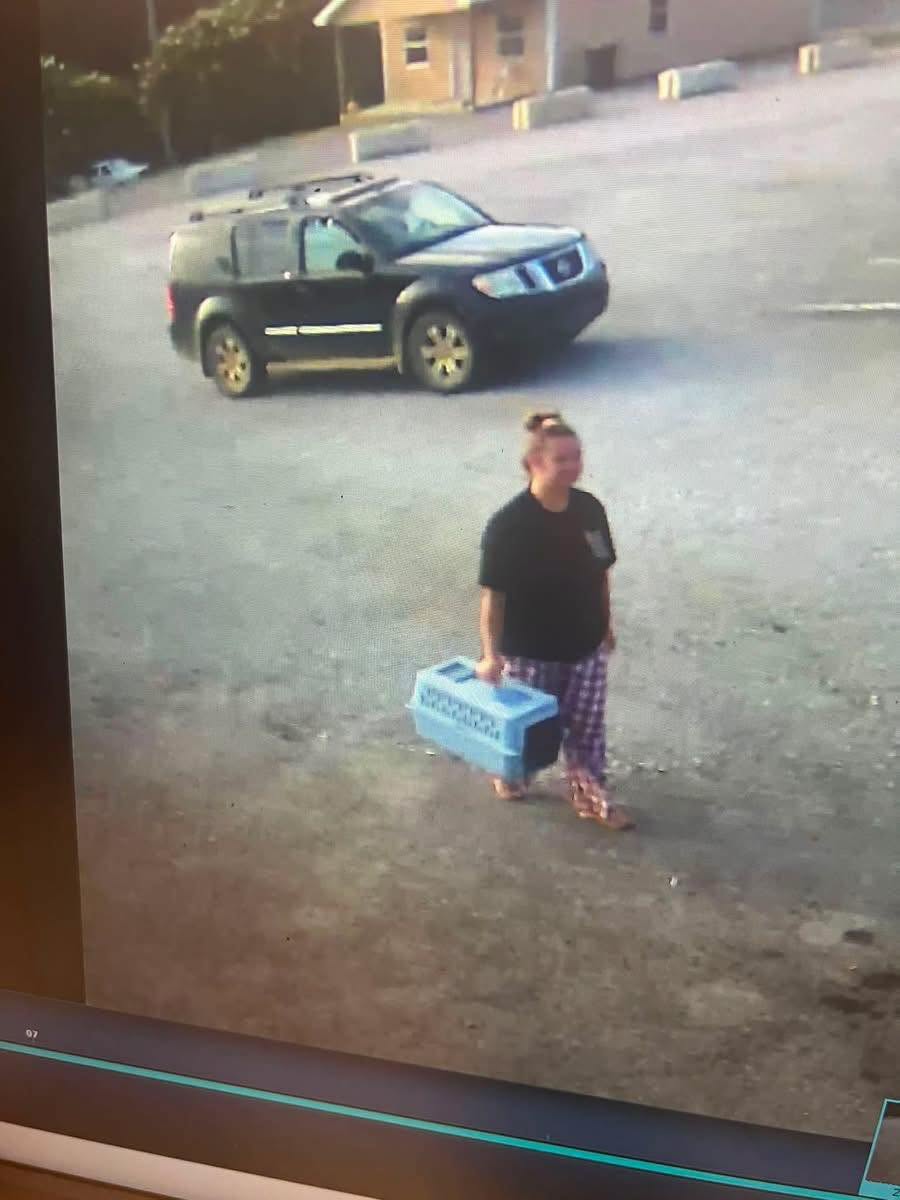
CULLMAN, Ala. – An adult female cat left unattended outside the Cullman County Animal Shelter before it opened Monday morning has prompted questions about the difference between legally surrendering an animal and abandoning one on shelter property.
Cullman County Animal Shelter Director Andrea Hudson told The Tribune the cat was left at approximately 7:54 a.m. Monday, Aug. 17. Although some early social media discussion referred to multiple kittens, Hudson confirmed that the incident involved one adult female cat.
Hudson said the shelter was closed when the cat was left in what she described as a filthy carrier without water. The animal remained unattended for approximately one hour before being discovered.
The cat is doing well and will remain safely at the shelter through a seven-day holding period before being made available for adoption, Hudson said.
Cullman County Animal Control Director Rodney Banister said the person had not been identified as of Monday. No criminal charge or citation had been announced.
The incident generated divided reactions online, including questions about why leaving an animal at the shelter would not constitute surrendering it.
Hudson said surrender is a formal process requiring contact with shelter employees, verification of information and a signed transfer of custody.
“Leaving an animal on shelter property without consent from an employee is considered abandonment, period,” Hudson said. “This causes multiple problems, including the safety of the animal.”
Shelter hours and intake procedures
The Cullman County Animal Shelter, located at 935 Convent Road NE, is open to the public from 9 a.m.-3:30 p.m. Monday through Friday. A sign on the property states that animals may not be left before operating hours without registration and warns that violators may be prosecuted.
Cullman County lists separate Animal Control complaint hours of 7:30 a.m.-4 p.m. Monday through Friday. Those hours do not create an unattended animal drop-off period.
Hudson said owner surrenders are accepted when the shelter has available space. An appointment may be required, although staff members try to avoid long waits whenever possible.
Anyone surrendering an owned animal or presenting a stray must provide a driver’s license and proof of Cullman County residency. The person signing the shelter’s legal paperwork must be at least 19 years old.
Cullman County does not charge a fee to deliver a stray or complete an owner surrender.
For an owner surrender, custody transfers to the shelter once the required legal document is signed. Simply placing an animal outside the building does not complete that transfer.
People presenting an animal as a true stray must sign a document stating that the animal does not belong to them or anyone they know and that it has been in their care for fewer than seven days.
The person must also disclose whether the animal has bitten or otherwise injured a person or another animal within the preceding 10 days.
Hudson said intentionally providing false information on the document could result in an arrest.
Why the information matters
Shelter employees need to know where an animal came from, whether it may have been exposed to rabies or another disease, whether it has displayed aggression and whether it belongs to someone who may be searching for it.
“We as staff don’t know a history of the animal,” Hudson said. “Is it sick? Has it been exposed to anything like rabies? Was it just found, and if so, where? Is the animal from another county? There are a lot of factors that go into taking an animal.”
Stray animals are held for seven days to provide their owners an opportunity to locate and reclaim them. After that period, an unclaimed animal may become available for adoption.
Hudson said the holding period also places unavoidable demands on shelter capacity. If seven stray dogs enter the shelter in one day, those animals occupy seven kennels throughout the holding period, regardless of how many additional animals arrive.
Routine owner surrenders involving contagious illness or aggression are not accepted because of the potential danger to other animals and the public, Hudson said. Injured, elderly, pregnant and very young animals may be considered individually.
The county’s published website states that owner surrenders cannot be sick or injured, aggressive, pregnant or older than 10.
Because Hudson said some of those circumstances may be evaluated case by case, residents should call the shelter before bringing an animal with special medical, behavioral or age-related needs.
Why there is no 24-hour drop-off area
Hudson said a round-the-clock surrender area would require 24-hour staffing, additional capacity and facilities capable of safely separating animals whose health and behavioral histories are unknown.
“If we had a 24-hour surrender process, we would be over capacity in less than 24 hours,” Hudson said.
An unattended intake area could also place healthy animals in contact with contagious ones or allow aggressive animals to injure others.
“It is not feasible, and it is not a safe situation at all,” Hudson said. “We would have no history on the animals.”
What to do after hours
Anyone who finds a stray or an animal requiring assistance after regular hours should contact the Cullman County Sheriff’s Office nonemergency dispatch line rather than leave the animal outside the shelter.
That number is 256-735-2425. Dispatch can contact Animal Control when appropriate.
Call 911 when an animal-related situation presents an immediate threat to human life or safety.
What Alabama law says
Banister directed The Tribune to Alabama Code Sections 13A-11-240 and 13A-11-241, which address cruelty to dogs and cats.
Section 13A-11-240 is a definitions section. It defines “cruel” as an act, omission or neglect, including abandonment, through which unnecessary or unjustifiable pain or suffering is caused or allowed to continue.
The section does not independently create a criminal charge. Its definitions are used in the related criminal provisions of Section 13A-11-241.
Under Section 13A-11-241, a person commits first-degree cruelty to a dog or cat by intentionally torturing the animal or engaging in certain conduct involving its fur, hide or pelt. First-degree cruelty is a Class C felony.
The statute defines second-degree cruelty as cruelly overloading, overdriving, depriving of necessary sustenance or shelter, beating, injuring or mutilating a dog or cat or causing such conduct to occur. Second-degree cruelty is a Class A misdemeanor.
“There are procedures in place to surrender animals,” Banister said. “The shelter works extremely hard to help people. Leaving an animal without proper water in the dangerous temperatures anywhere confined in a carrier is a crime. Abandoning an animal anywhere is not acceptable.”
Nothing provided to The Tribune alleges that the cat was intentionally tortured. Whether leaving the cat unattended without water satisfies the elements of second-degree cruelty or another offense must be determined by investigators, prosecutors and, if a charge is filed, the courts.
No person had been charged in connection with Monday’s incident as of publication.
Hudson said the shelter’s immediate concern was the danger created when the cat was left without water, supervision or a completed intake history.
“Animals should never be discarded at any location, period, especially without water or food,” Hudson said. “They deserve better. Animal ownership is a privilege, not a necessity.
“Regardless of what people may say or believe, we are here for the safety and well-being of the animals in our care, and we do everything we can to make a better tomorrow for them.”
The Cullman County Animal Shelter can be reached at 256-734-5448.