











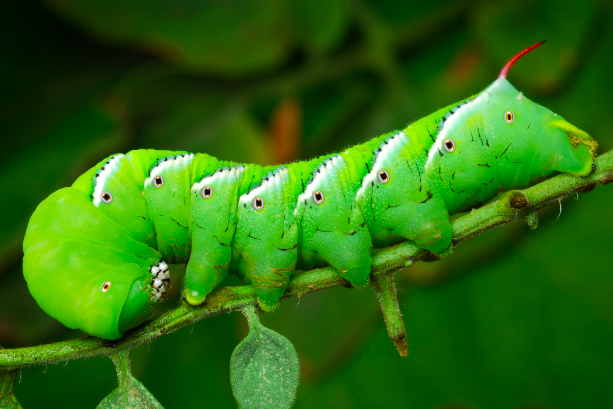
Hornworms are bright green and look similar to caterpillars, but are just hawk moth larvae. These seemingly innocent things are the biggest threat to your garden.
They are ravenous eaters and can be found in eggplant, pepper and tomato plants or any plants in the nightshade family. Their bright green color makes it hard to differentiate between your plant and the hornworm itself.
A tip to tracking down these creatures, aside from following the buffet trail, is to use a black light. Hornworms have bioluminescent properties which allows them to glow under a black light.
Cullman County Master Gardeners advised that you can tell their location and size by their droppings, and the bigger the dropping the bigger the worm.
“Their droppings are almost neon green and dry brown, so if you see neon green, or even a lighter green, you should look around in that area. If the droppings are dark brown they may have moved on.”
Though locating them is half the battle. Once you’ve found them, you will have to search for the hornworm eggs.
“You have to pick them and their little eggs off your plants or else they are doomed to be eaten. The eggs are very tiny, slightly shiny and white, or pale in color. They are sticky so you have to pick them off with your fingers,” they emphasized.
While eggs are usually laid in groups, the gardeners also mentioned finding single eggs on tomato leaves.
While there are ways to keep the hornworms out of the garden the best thing you can do is ensure the larvae and their eggs are picked off the plants.
Additional tips from Cullman County Master Gardeners include:
- Try to keep tomato plants trimmed
- Make sure no leaves touch the ground
- Thin the leaves on the stems to make them easier to inspect
- Watch for missing blossoms, chewed leaves and droppings
Hornworms will munch on the whole plant: leaves, tomatoes and blossoms, but they can usually be found on the undersides of the leaves.