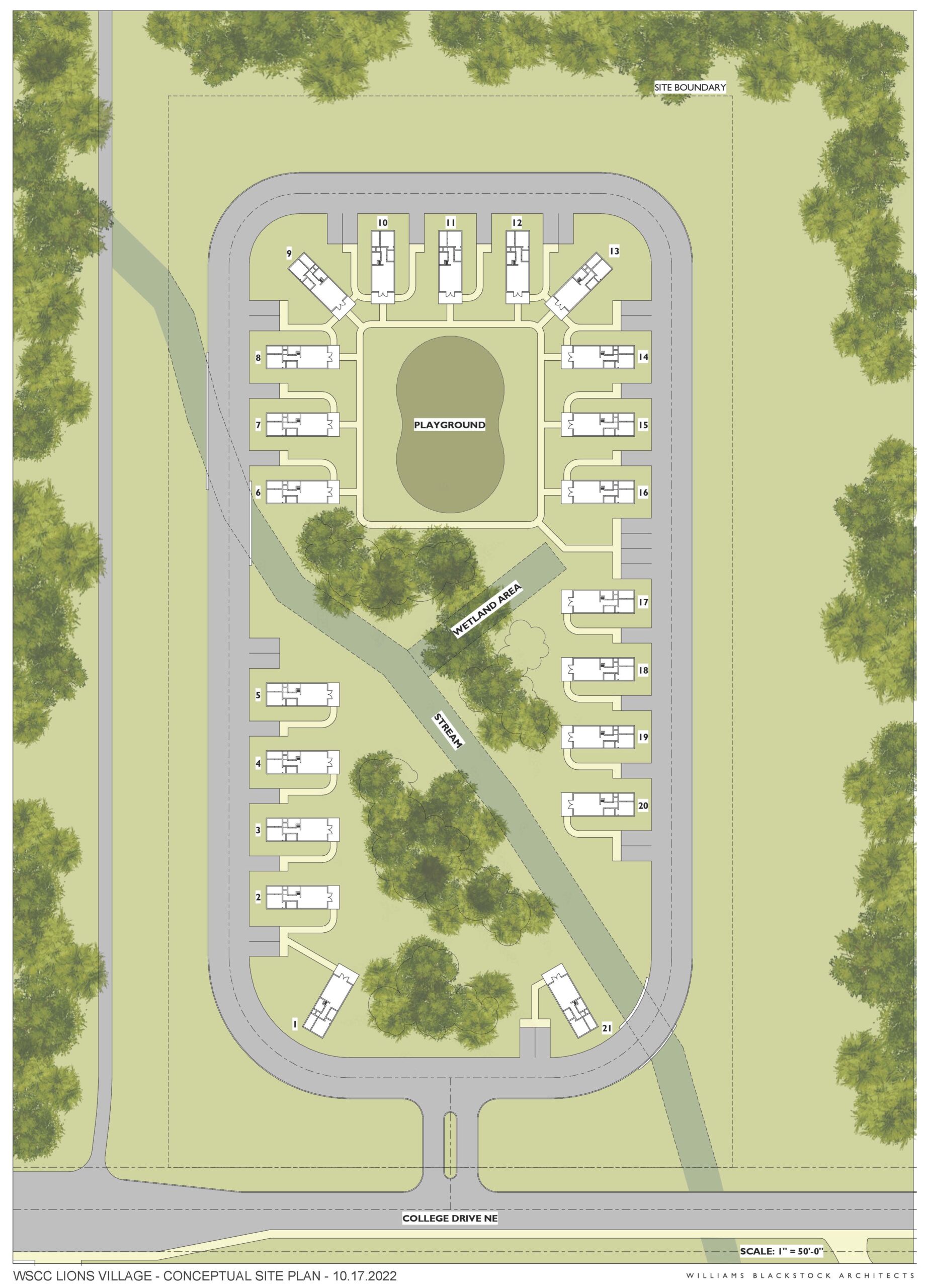
HANCEVILLE, Ala. – For many who decide to pursue college, adjusting to campus life can be a challenge. Balancing classes, financial aid and simply learning how to navigate a new campus environment is often enough to fill a student’s plate. Now, add a child into the mix. The challenge grows and often stonewalls many prospective students from even enrolling at all. Wallace State Community College hopes to change that narrative with the creation of the Wallace State Lions’ Village, a project designed to address two of the most significant obstacles facing student-parents: affordable housing and accessible childcare.
The planned residential community will include 10 micro-dwellings, fully equipped to provide most of a student family’s needs. The village is designed to accommodate expansion to 20 dwellings, along with an on-site childcare center featuring four classrooms and a designated tornado shelter serving both residents and the surrounding community.
Suzanne Harbin, vice president for advancement and innovation at Wallace State, shared that the project emerged from a clear and pressing need.
“The Wallace State Lions’ Village is an innovative residential community designed specifically for student-parents — one of the fastest growing, yet most underserved, student populations,” Harbin said.
“This project became a priority because affordable housing and childcare access are barriers tied directly to student access and success,” she explained. “Cullman County faces a 48.7% childcare capacity gap, leaving a shortage of more than 1,600 slots for young children. When students cannot secure stable housing or reliable childcare, enrolling in college and continuing their education becomes nearly impossible. The Lions’ Village is our proactive answer to those challenges.”
The project became a funded reality through Congressman Robert Aderholt, R-Alabama’s support via Congressionally Directed Spending. He secured $2,540,000 through the U.S. Department of Housing and Urban Development for the development.
“Congressman Aderholt’s support was the catalyst that moved this project from a vision to a fully funded initiative,” Harbin said. “For Wallace State students, it means the college can now offer a comprehensive support model that meets foundational needs, safe housing, affordable childcare and a stable environment, so students can focus on completing their education.”
Unlike stand-alone “tiny homes,” the Lions’ Village follows closer to the “micro-housing model,” designed for permanent campus integration. The homes will be built on foundations and meet residential building codes, forming a planned community that emphasizes walkability, family functionality and proximity to many campus services.
“At an average of 500 square feet, these homes prioritize efficient use of space, stability and access to wraparound services, making them ideal for student families in a campus environment,” Harbin said.
With the inclusion of an on-site childcare center, Wallace State hopes to help eliminate much of the daily transportation challenges for student-parents juggling home, daycare and class schedules. The addition of a tornado shelter provides critical protection in a region where severe weather is a recurring concern. All of these features are being developed with student-family income levels in mind, ensuring the housing remains affordable for families with limited financial resources.
Beyond housing and childcare, Harbin emphasized that the Lions’ Village is designed as a collaborative, community-supported initiative. Partners, including Community Action Partnership of North Alabama (CAPNA), the Cullman and Hanceville Housing Authorities, The Link of Cullman County, Cullman Caring for Kids and the WSCC Future Foundation, will each play a role in strengthening the support network surrounding student-families.
CAPNA will contribute expertise in early childhood education and housing program management, while the Cullman and Hanceville Housing Authorities will assist with access to attainable housing resources and resident services. The Link will provide wraparound and crisis-support services to promote healthy long-term stability for the student-families, and Cullman Caring for Kids will help connect families with food and essential resources. Harbin noted that the WSCC Future Foundation has been instrumental in working to provide the land that makes the Lions’ Village development possible.
“The Lions’ Village is built on strong community partnerships, which ensure the project is not just housing, but a true support ecosystem,” Harbin said. “Together, these partners expand the reach of services, enhance community-based support and ensure families have what they need to thrive.”
But the goal doesn’t stop there for the Wallace State vision and its aspirations to do more for student-parents to ensure their success. For many students, especially those who are student-parents, who have found themselves face to face in the cycle of family poverty, Wallace State hopes to provide the ability to break the wheel as they earn degrees, giving them an opportunity to earn higher wages and grow the local workforce.
Additionally, with this foundation, Wallace State hopes to be able achieve greater student retention while taking away some of the burden that comes with being a student parent and giving them their best chance at success.
“Our long-term vision is to create lasting, generational change,” Harbin said. “The Lions’ Village will help families build stability, help Wallace State foster student success and help the Cullman County community grow stronger for generations.”