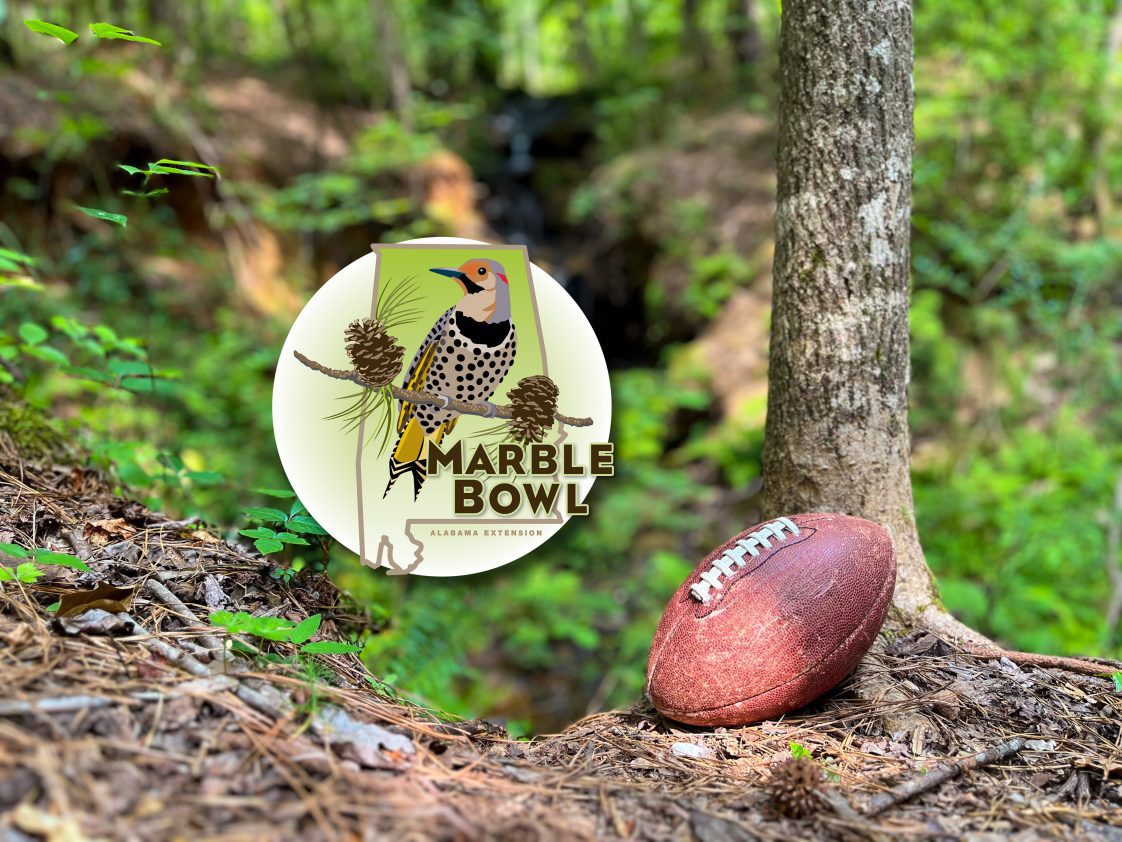
AUBURN UNIVERSITY, Ala. – The stakes are higher than ever as the Marble Bowl competition expands to include at least a dozen colleges and universities in Alabama and their fan bases. A play on the Iron Bowl title, the Marble Bowl has previously pitted Auburn University and University of Alabama fans against one another as citizen scientists help researchers identify and track wildlife populations across the state. This year, Marble Bowl organizer Wesley Anderson said the participation universities across the state sets this year up to be the most exciting yet.
“Alabama is blessed with incredible biodiversity and is among the highest in the nation,” said Anderson, an Alabama Extension at Auburn University forestry, wildlife and natural resources specialist. “With these facts in mind, the increased need for documenting biodiversity around the state becomes clear.”
Anderson said citizen science is a strong contributor to widespread research. He said the reality is that nearly anyone can contribute to science if they want to.
“Our world is changing rapidly, and we need to develop a baseline of what biodiversity in our state looks like now so down the road we can assess how it differs and what we should do about it,” Anderson said. “This means observations made around where you live, work and play have value.”
The Marble Bowl
In creating the Marble Bowl, Anderson coordinated efforts with the Alabama Museum of Natural History, Auburn University Museum of Natural History and Auburn University College of Forestry, Wildlife and Environment.
Now through the weekend of the Iron Bowl, Alabamians can participate in the Marble Bowl by submitting observations of wild plants, animals and fungi to one of two projects on the iNaturalist platform. This online site stores crowdsourced, public observations of biological organisms. Listed below are the necessary steps to participate.
- Visit inaturalist.org and sign up for a free account. There is also a mobile application for smart devices.
- Join the “The Marble Bowl” project to keep up with the current score.
- Within The Marble Bowl umbrella project, join the project of the team you would like to support. Be sure to only join one team project or your scores will cancel each other out.
- To document an observation, you may shoot photos of wild organisms with your cell phone or camera.
- Because cell phone photographs are automatically timestamped and geotagged, all of the necessary information is already with the photograph when you upload it. If you prefer to take photos with a digital camera, be sure to note the location and include it with your observation if the camera doesn’t geotag it for you.
- Observations may be uploaded to iNaturalist through a web browser or the app. As you submit observations, the platform’s artificial intelligence will suggest an identification based off what is in the photo along with similar species that have already been observed nearby. You are allowed to suggest a different identification if you’re confident about what you saw. Select a species and then submit your citizen science observation.
Ground rules
To make sure that the contest is fair and remains competitive, there are a list of rules to follow.
- Winner. The winner of this competition will be the project that has the highest score out of 100 points.
- Location. Observations must occur within the state of Alabama.
- Date and time. Observations must occur between kickoff weekend (Midnight Saturday, Aug. 30) and the end of Iron Bowl weekend (11:59 p.m. Sunday, Nov. 30). No photographs taken before this time can be used.
- No captive/cultivated observations. As much as people may love their pets, they aren’t suitable subjects for iNaturalist observations. The goal of this project is to record observations of wild plants, animals, fungi and other organisms across the state. Pets–along with other domesticated animals like horses, chickens and goats–should not be added to the project. Observations of cultivated plants are not allowed either.
- Quality grade. To be counted in the competition, observations must meet the criteria for Research Grade or Needs ID. Read about those classifications on the iNaturalist website.
“With so many schools participating this year, this is sure to be the most exciting Marble Bowl yet,” Anderson said. “Regardless, if your school is the champion, I can already predict our efforts to conserve biodiversity in the state of Alabama is going to be the real winner.”
More information
The Marble Bowl is the perfect opportunity to carry some extra bragging rights during football season in Alabama. Learn more about the Marble Bowl by visiting the Alabama Extension website at aces.edu.