








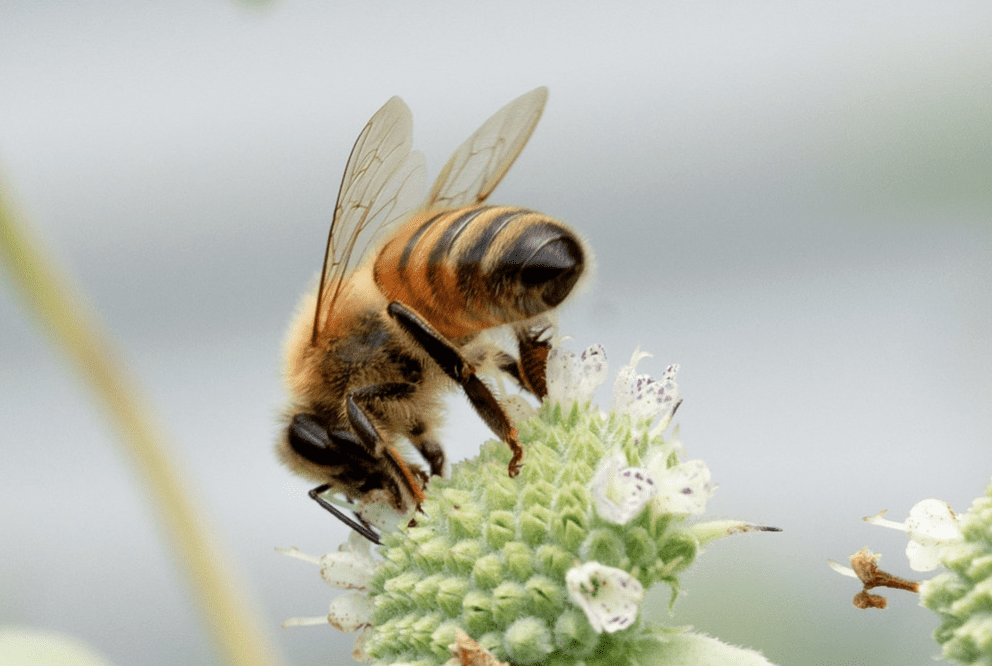
AUBURN UNIVERSITY, Ala. – Bees appear to be social creatures, as they frequently congregate on flowers or nest in plain sight. At the Auburn University Bee Center, researchers and students are digging deeper into the complexities of the sociality of bees.
Alabama Agricultural Experiment Station researcher Anthony Abbate works with the team at the Auburn Bee Center as an assistant professor. Together, they conduct research within the Department of Entomology and Plant Pathology.
“Our graduate student Sara Kirby really took the reins on this effort,” Abbate said. “In this enterprise, we try to raise people’s awareness on how bees coexist. That helps us analyze their unique sociality through their interactions and working patterns.”
The team collects pollinators from wildflower and tillage plots at the E.V. Smith outlying unit of the Alabama Agricultural Experiment Station. The collected specimens show the researchers various trends, ranging from diversity of forages to nesting habits. The team also examines individual species more closely for social patterns.
Selina Bruckner, an assistant professor with Alabama Extension at Auburn University, said that even knowledgeable beekeepers could benefit from considering bee social structures.
“The main goal of any bee is to have offspring that will carry on their genes,” Bruckner said. “In solitary species, this goal is dependent on one single male and one single female bee. If any of them dies, either before mating or laying eggs, there is no chance for their genes to get passed on. Thus, solitary bees are more susceptible to factors that could negatively affect reproduction.”
Bee lifestyles
This effort explores the primary types of bee lifestyles: solitary, eusocial and parasocial.
Roughly 90% of the bee species in the U.S. are solitary. In this behavioral pattern, mature females build nests for themselves and collect pollen and nectar for their young. Around 70% of these bees are ground-nesters. They dig underground where they raise their offspring until maturation. The remaining 30% are cavitynesting species that rely on natural tunnels and crevices for nest sites.
Eusocial species are the polar opposites of solitary bees and could be considered the socialites of the bee world. Eusocial bees work together within a colony. These bees care for the brood as a whole, divide labor and live together for generations. Perhaps the bestknown members of this group, bumblebees and honeybees provide much of the pollination the world depends on.
Falling in-between solitary and eusocial species, parasocial bees show some but not all the traits of eusocial bees.
Breaking down parasocial bees
Within this classification there are semisocial, quasisocial and communal bees.
“Parasocial bees are interesting because they blur the line between social and solitary lifestyles, having some characteristics of each,” said Sara Kirby, graduate research assistant for the Auburn Bee Center. “Because their behaviors are so variable, it can be difficult to assign social classifications to them and to study them consistently across larger areas.”
Semisocial bees are almost, but not quite, eusocial. They lack the trait of generational nests. Because they grow at the same pace and are part of a single generation, they synchronize work efficiently.
With quasisocial bees, the females work together to build one nest. Then, they all lay eggs. In this group, the work is equally shared, creating a more democratic spirit as they collect pollen and guard the nest.
Communal bees are the last of the parasocials. In this unit, many females live in the same nest, but they do not coordinate efforts and only feed their own young. These more individualistic bees are less involved with the care of their offspring. However, they still reap the benefits of living communally, which include limited predators and an overall safer nest.
“Many parasocial species are also socially plastic, meaning they can shift between different social structures,” Kirby said. “This depends on environmental conditions, such as resource availability, population density or season length.”
Each one of these social structures has its own distinct purpose in the pollinator ecosystem.
Bee-ing helpful
Bruckner says that the Auburn Bee Center exists to connect research with the needs of those they serve.
“The research at the Bee Center is very much applied; we directly take the results and convert them into recommendations for stakeholders,” Bruckner said. “We convey these recommendations through online articles, presentations and trainings.”
With nearly 500 native bee species in Alabama, continued monitoring and Auburn Bee Center research reveals how vital their diversity is to our ecosystems.
To learn more about the lifestyles of bees, read the publication Lifestyles of Alabama’s Bees. It can be found online at aces.edu.