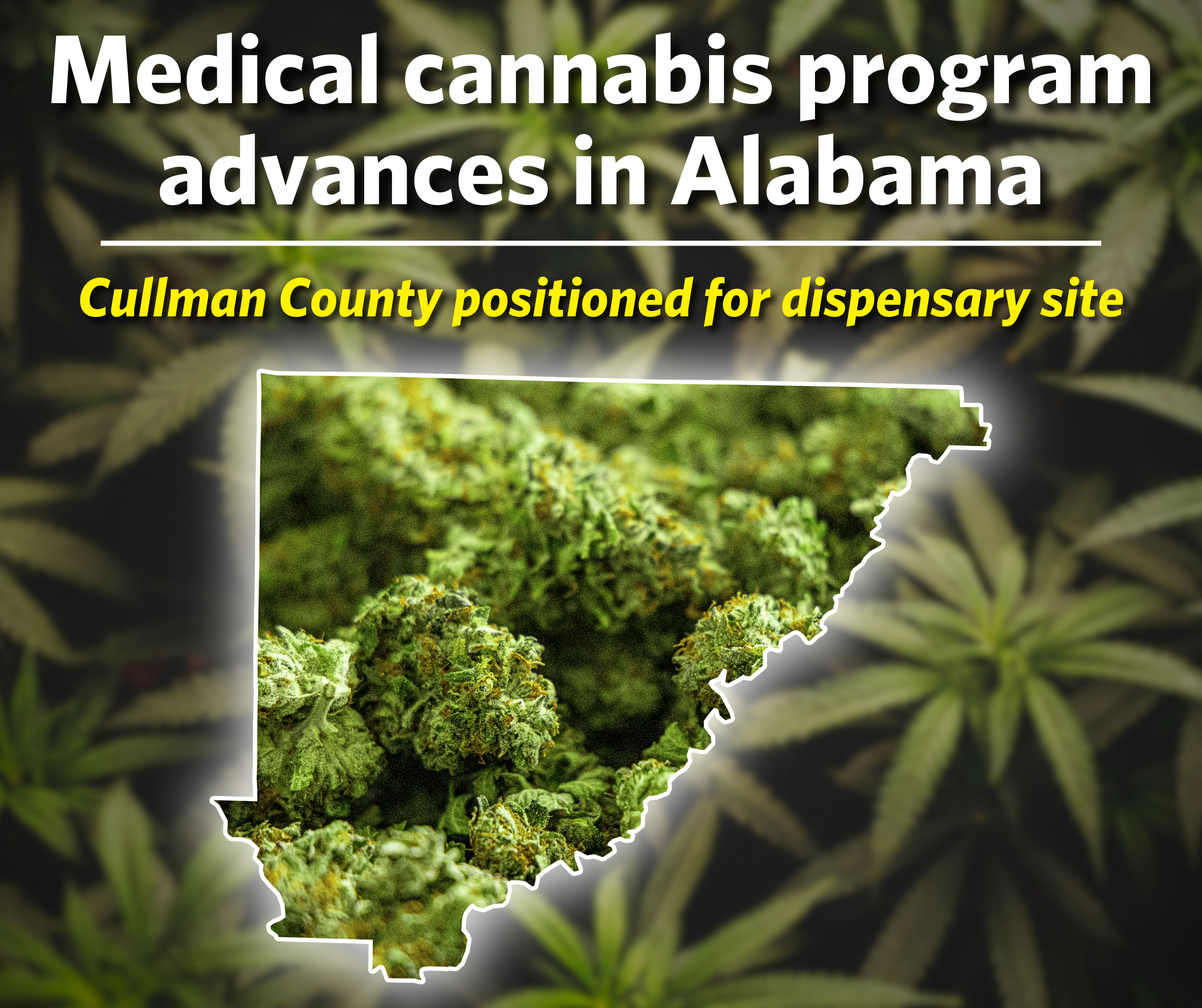
CULLMAN, Ala. – Alabama’s long-delayed medical cannabis program is moving closer to becoming operational following recent action by the Alabama Medical Cannabis Commission. Cullman County remains positioned as a future dispensary location after years of regulatory delays and legal challenges.
The program was authorized by the Alabama Legislature in 2021 through the Darren Wesley “Ato” Hall Compassion Act. The law legalized marijuana strictly for medical use under a tightly regulated, in-state system. Recreational marijuana remains illegal under Alabama law.
In December 2025, the Alabama Medical Cannabis Commission voted to issue the state’s first dispensary licenses. The decision marked a significant step forward after repeated pauses, rescinded decisions and court intervention stalled implementation for more than two years.
Several dispensing sites are planned across Alabama, including one in Cullman County. Products are not yet available for purchase, and no opening date has been announced. State officials say the program has entered its final administrative phase.
Alabama’s medical cannabis program is among the most restrictive in the country. Smoking or vaping marijuana is prohibited. Raw plant material will not be sold.
Approved products include capsules, tablets, tinctures, topical creams, gels, oils, transdermal patches, suppositories, nebulizers and measured inhalers. All medical cannabis sold in Alabama must be grown, processed and dispensed within the state by licensed businesses overseen by the Alabama Medical Cannabis Commission.
Cullman County’s connection to the program has been shaped largely by Wagon Trail Med-Serv. The local company pursued an integrated facility license that would allow cultivation, processing and dispensing.
In June 2023, the Alabama Medical Cannabis Commission initially awarded integrated facility licenses. Days later, the commission held an emergency meeting and placed those licenses on hold, citing inconsistencies in application scoring. Wagon Trail Med-Serv was among the affected applicants.
When the commission reissued licenses in August 2023, Wagon Trail Med-Serv was denied an integrated facility license a second time. Company leadership appealed the decision and continued working with state regulators.
In December 2023, the commission again voted to award integrated facility licenses. Wagon Trail Med-Serv was among the businesses selected. Pre-issuance inspections followed, signaling progress toward final licensure.
Joey Robertson, CEO of Wagon Trail Med-Serv, said the company remained focused on patient access despite the prolonged delays.
“We have had such good support locally; it’s been tremendous and so positive,” he said. “We just want to get this medicine to people that need it.”
Legal challenges again slowed the rollout in early January 2024. A temporary restraining order halted issuance of integrated facility licenses statewide.
Robertson said inspections showed the company is prepared.
“The pre-issuance inspection went well,” he said. “We were able to demonstrate that everything in our application was factual and ahead of our initial projected timelines.”
Court action later cleared much of the remaining litigation. That allowed the commission to resume licensing steps through 2024 and into 2025. By late 2025, the commission moved forward with issuing dispensary licenses statewide, shifting the program from planning to implementation.
No cannabis cultivation or processing facilities are currently operating in Cullman County. State licensing records continue to list the county as a dispensary location once final approvals, zoning and permitting are completed.
Under Alabama law, physicians are now permitted to become registered and licensed to recommend medical cannabis to eligible patients. Doctors must hold an active Alabama medical license and complete required training before registering with the Alabama Medical Cannabis Commission. Once approved, physicians may certify that a patient has a qualifying condition and that medical cannabis is an appropriate treatment option.
Physicians do not issue traditional prescriptions for medical cannabis. Instead, they provide a certification that is entered into the State’s medical cannabis registry. That certification allows a patient to apply for a medical cannabis card through the State system and purchase products only from licensed dispensaries.
Doctors are not required to participate in the program, and patient access depends on the availability of registered physicians willing to evaluate and certify eligibility under state law.
Medical cannabis in Alabama is available only for conditions specifically listed in state law. Qualifying conditions include:
- Autism spectrum disorder
- Cancer-related symptoms including cachexia, nausea, vomiting, weight loss or chronic pain
- Crohn’s disease
- Depression
- Epilepsy or seizure disorders
- HIV/AIDS-related nausea, vomiting or weight loss
- Panic disorder
- Parkinson’s disease
- Persistent nausea not adequately responsive to conventional treatment
- Post-traumatic stress disorder
- Sickle cell anemia
- Spasticity associated with amyotrophic lateral sclerosis, multiple sclerosis or spinal cord injury
- Terminal illnesses
- Tourette’s syndrome
- Chronic or intractable pain when conventional therapies have failed or are contraindicated
Physicians may recommend medical cannabis only for conditions within their area of training and expertise.
To legally purchase medical cannabis in Alabama, patients must be state residents with a qualifying condition. They must be evaluated in person by an Alabama-licensed physician certified by the commission. Telemedicine evaluations are not permitted.
If approved, the physician enters the recommendation into the State registry. Patients then complete registration through the Alabama Medical Cannabis Commission to receive a medical cannabis card. Registered caregivers are subject to background checks and limits on how many patients they may serve.
State and local law enforcement agencies emphasize that marijuana remains illegal outside the confines of the Compassion Act. Possession without a valid medical card or outside program limits remains a criminal offense. Impaired driving laws remain unchanged.
Physicians participating in the program are regulated by the Alabama Board of Medical Examiners. They are prohibited from holding financial interests in cannabis businesses or receiving compensation from licensed operators.
With dispensary licenses now issued and major legal challenges resolved, state officials say the focus is shifting to final inspections, permitting and patient certification. Dispensary operators are securing locations, physicians are preparing to certify patients and the Alabama Medical Cannabis Commission continues administrative oversight.
For Cullman County residents with qualifying medical conditions, the coming months could mark the first opportunity for legal medical cannabis access locally. Officials caution the rollout will remain measured and tightly regulated.