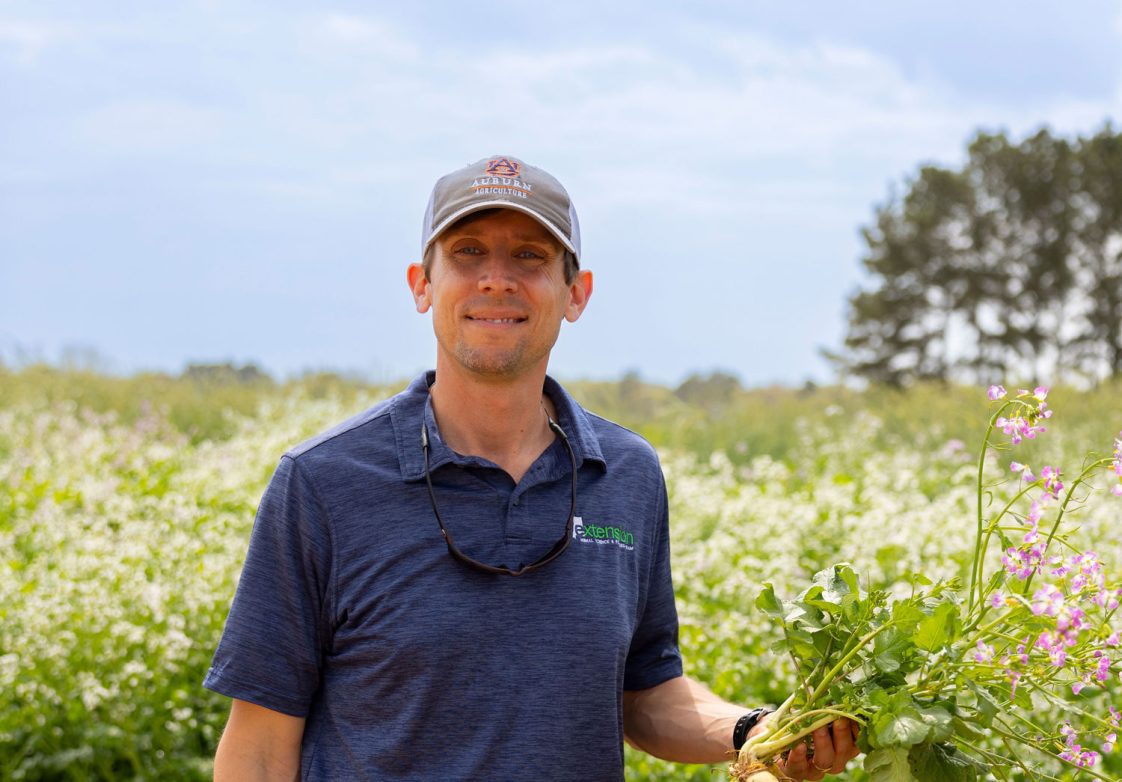
AUBURN UNIVERSITY, Ala. – In the heart of the Mississippi pine belt, about an hour south of Jackson, stood a small cattle farm, where working hard and making do with what you had was a fact of life. For a young David Russell, this rural scene of pine trees, cattle pastures and hayfields was home. Today, his Mississippi roots — experiences working on the farm, learning lessons from his family and living a rural Mississippi lifestyle — inspire Russell’s work in Alabama fields. Through his roles with the Alabama Cooperative Extension System and Auburn University, he holds the memories of his family’s farm close as he strives to make a difference in the lives of Alabama farmers.
On their Mississippi farm, Russell’s dad managed the cattle and land the way that his dad and others in their rural community taught him. Whether that was the right way or the wrong way, he didn’t know, but the family worked hard to do the best they could and enjoyed country living.
“Dad would occasionally ask for help from guys at church and whoever he drank coffee with, but most of the time, he just figured things out on his own,” Russell said. “Like most people with middle-to-lower incomes, just figuring out how to do stuff was part of life.”
Hard work was a pillar in the Russell household, both on and off the farm. Like many small-scale farmers, Russell’s dad worked an additional full-time job. He was a surveyor, and later a field inspector, with the Mississippi Department of Transportation. Russell’s mom also worked full time as an accountant for a private company. Russell and his brother provided a lot of the muscle and labor on the farm, as they helped their dad build fences, haul square hay bales and do anything that needed doing.
College days
While neither of his parents had a college degree, they valued education and pushed Russell to achieve more than they had.
“Even though they didn’t have the experience of navigating the collegiate world, they did what they had to do to get me there,” Russell said. “One thing that nobody can ever take away from you is an education. I think that has proven true and taken me a lot of places and given me a lot of opportunities.”
While he was still deciding what path to pursue for his major, Russell attended two years of community college. From a young age, he had an appreciation for the outdoors and art. It was a conversation with a department head at Mississippi State University during a career fair that made Russell realize he could combine both into one career.
“It was my grandmother who drove my appreciation for art,” Russell said. “In a lot of people’s minds, art is completely separate from production agriculture and nature. But landscape architecture combined both of those interests for me.”
Introduction to Extension
After earning his bachelor’s degree, both interests were still there, but Russell didn’t see himself sitting behind a drafting table his entire career. That led him to pursue a master’s degree in agronomy, working with native plants, and a doctoral degree in plant and soil sciences, concentrating in weed science. During this time, Russell was first introduced to Extension.
Even though Mississippi has an active service, Extension was a foreign concept to Russell and his family’s farming operation. Thanks to his Mississippi State mentors, John Byrd and Gary Jackson, Russell learned all about Extension’s far-reaching impacts. During his doctoral studies, Russell worked full time for more than six years as an Extension associate in Byrd’s forage and noncrop weed management program.
In this role, Russell saw the positive impacts Extension can have on a person’s farm, when growers adopted practical recommendations that came from his research efforts. This made him think back to his own family’s farm and how different things could be done. As an adult, Russell put his new knowledge into action, being the first person to send in a soil test for his dad’s operation.
“On our farm, things were done a certain way because that was the way they had always been done,” Russell said. “In Extension, you are bringing information to people who may not even know they need that information. I often think about all the ways my dad and our farming operation could have benefited from the shared knowledge delivered by an Extension educator.”
This realization and other experiences at Mississippi State heavily influence Russell today in his roles as an assistant Extension professor and Auburn researcher.
Alabama fields
Russell’s expertise in weed management runs the gamut. He helps people — including forage and livestock producers, row crop farmers, landowners, property managers, homeowners and even right-of-way managers — understand the importance of a solid weed-management program.
Whether he is providing control recommendations for dogfennel and horsenettle in a pasture or working with a wheat farmer to control Italian ryegrass, Russell works year-round to address the needs, questions and concerns of Alabama residents. A hallmark of these recommendations is that they are fully supported by science-based research that is conducted on local, regional and state levels through the Alabama Agricultural Experiment Station system.
Russell’s goal is to be a trusted source of timely and practical information while helping people address their immediate needs and providing options for long-term strategies. To accomplish this, he is focused on building and maintaining relationships with people who can serve as Extension’s ambassadors in local communities.
“Growing up, the decisions we made on the farm were based on how our neighbors or friends did it,” Russell said. “That was our circle of influence there in that small community. My dad was not one to venture outside of that circle and attend something like an Extension field day or meeting. A lot of times, to reach people like my dad, it’s going to take knowing the influencers in a community. This is why having Extension at the local level is so critical.”
While he is a faculty member, Russell does not formally teach in a classroom. For him, the fields, pastures and forestlands across the state are his classrooms, and they change every day. That is what he enjoys most about working for Extension. People all learn in different ways, and he enjoys the freedom to build educational experiences to meet those needs.
“It’s this very thing — making a difference in the lives of others — that keeps me going and makes me love my job,” Russell said.