











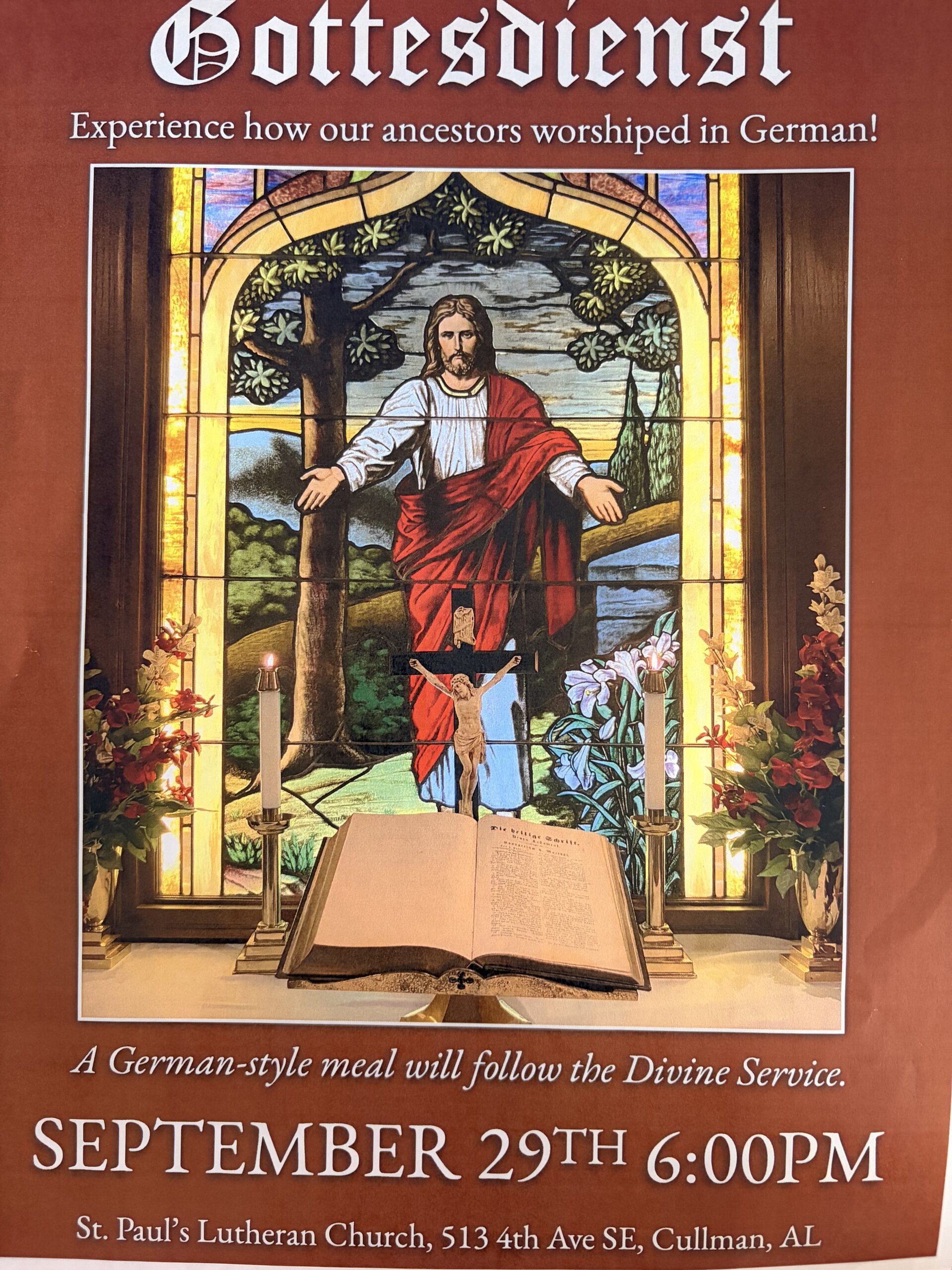
CULLMAN, Ala. – St. Paul’s Lutheran Church invited the community to step back in time Tuesday evening, Sept. 29, for a Gottesdienst, a worship service in German modeled on how Cullman’s early settlers would have worshiped.
The 6 p.m. service at the church, 513 Fourth Ave. SE, was billed as a chance to “experience how our ancestors worshiped in German!” A German-style meal with traditional entertainment followed in the church gym.
According to the church’s service bulletin, the service was “an approximate historical replica” of what a Gottesdienst would have looked like, without Holy Communion, when Col. John Cullman came to Cullman in the 1870s. The hymns, readings and prayers closely followed the traditional pattern for a Sunday morning service.
“But this order of service goes beyond just Cullman,” the bulletin reads. “This order of Divine Service is a very ancient tradition which goes back to the earliest days of the Church. Although they would have had different melodies and a different language, this order of service is something which Christians have enjoyed throughout the world for nearly two thousand years.”
A feast day in German
The evening fell on the Day of St. Michael and All Angels, a traditional church feast also known as Michaelmas. The bulletin’s cover carried the title in German, “Tag des Erzengels Michael und aller Engel,” along with an engraving of the archangel Michael and the congregation’s German name, “Die Evangelisch-Lutherische St. Pauli Gemeinde zu Cullman, Alabama.”
English translations were printed in italics throughout the bulletin so that “everyone can follow along, no matter how much German you know.” Worshipers were encouraged to sing the hymns and join in the congregation’s spoken parts, with the choir singing to help lead them.
What “Gottesdienst” means
Gottesdienst, pronounced GOT-us-deenst, literally translates to “God’s Service.” In the Lutheran Church, the term refers to the Sunday morning gathering of Christians, known in English as the Divine Service.
The bulletin explained that the name is meant to describe God serving His people rather than people serving God, pointing to the account in John 13 of Jesus washing His disciples’ feet.
“It does not mean ‘our service to God’—no, far from it! What it means is God’s service to us,” the bulletin reads.
The church closed its welcome with an invitation: “We are blessed by your presence among us, and we pray that today’s Gottesdienst is a blessing to you.”
Honoring Cullman’s German roots
The service came as Cullman celebrates its German heritage with Oktoberfest,.
St. Paul’s Lutheran Church holds regular Sunday services at 8 and 10:30 a.m. and invited those who attended Tuesday to return and worship with the congregation.