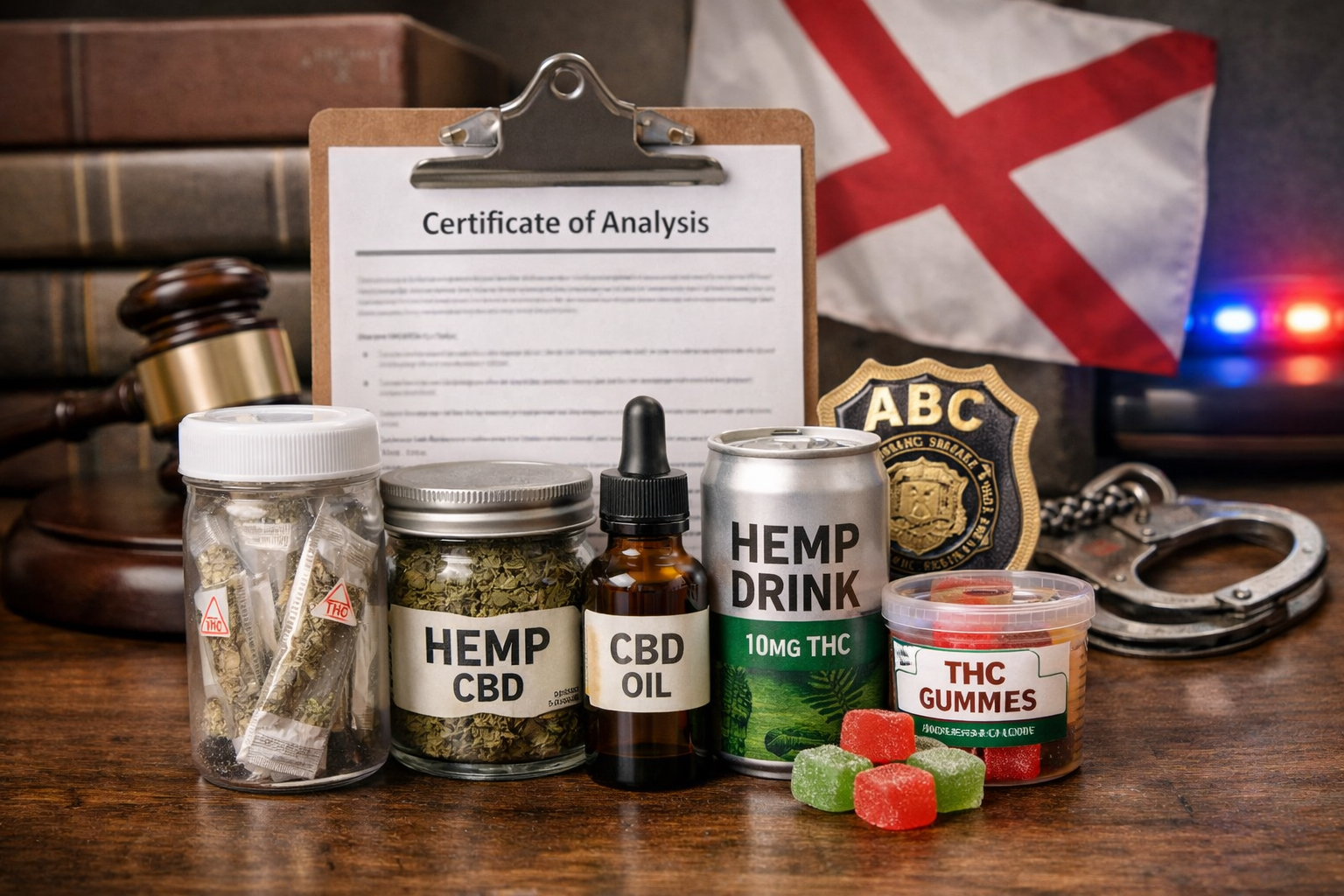
CULLMAN, Ala. – Alabama’s new hemp law, Act 2025-385, places sweeping restrictions on the sale, possession and distribution of hemp products in the state, according to an overview provided by Cullman County District Attorney Champ Crocker.
The act, also known as HB 455 and sponsored by Rep. Andy Whitt, R-Harvest, makes all hemp plant material and any smokeable hemp products unlawful in Alabama.
“All hemp plant material and any smokeable hemp products are unlawful and banned,” the act states.
While Crocker said he could not comment on pending investigations or specific law enforcement strategies, he outlined the key provisions of the law now in effect.
Under Act 2025-385, consumable hemp products are subject to the following requirements and restrictions:
- Consumable hemp products may only be sold in stores restricted to customers age 21 and older, with mandatory ID checks for all buyers.
- All consumable hemp products sold or distributed in Alabama are governed by rules adopted and administered by the Alabama Alcoholic Beverage Control Board.
- Hemp products must be tested and accompanied by a Certificate of Analysis issued by an accredited laboratory. The certificate must be available for inspection at every point in the supply chain, including retail, for each product batch.
- If a Certificate of Analysis cannot be produced at the point of retail, the product is considered contraband and may be seized by law enforcement or an ABC agent without a warrant.
- All hemp-derived products are prohibited from containing psychoactive cannabinoids that are created through chemical synthesis, modification or conversion from another cannabinoid using non-cannabis materials.
- Consumable hemp products must be individually wrapped and sold in strict child-resistant packaging, with required labeling and warnings.
- Consumable hemp products may not exceed 10 milligrams of total THC per serving and 40 milligrams of total THC per package.
- Direct shipment sales, online sales and drive-through sales of hemp products are prohibited.
- Criminal penalties for violating sales provisions range from a Class A misdemeanor to a Class C felony for subsequent offenses.
Additional restrictions apply specifically to hemp beverages:
- Hemp beverages may only be sold in 21-and-older stores or in grocery stores licensed by the ABC Board.
- Eligible grocery stores must dedicate at least 75 percent of their sales area to food, be at least 14,000 square feet and place hemp beverages in an area separated from nonalcoholic beverages and beverages marketed to children, with hemp-specific signage.
- Hemp beverages may not exceed 10 milligrams of total THC per 12-ounce serving.
- Hemp beverages may not be offered for consumption on licensed premises, and retailers are prohibited from offering tastings.
The law also establishes escalating civil penalties:
- Individuals selling hemp products in violation of the act face fines ranging from $1,000 to $5,000 for first through third offenses.
- Retailers face fines ranging from $5,000 to $10,000 for first through third offenses.
- Retailers found to have sold hemp products to minors face penalties ranging from $5,000 to $20,000 and may also lose their retailer license.
In addition, all proceeds, property, equipment, materials and personal property used in the illegal sale or possession of hemp products are subject to forfeiture proceedings.
Crocker also noted that a new federal law, passed by Congress in November 2025, will take effect in November 2026 and further tighten restrictions nationwide.
That law, HR 5371, Section 781, mirrors Alabama’s statute in several respects while imposing stricter standards in others. Key federal provisions include:
- An amended federal definition of lawful hemp that excludes cannabinoids synthesized or manufactured outside the cannabis plant.
- A new federal limit of 0.4 milligrams of total THC per serving, significantly lower than Alabama’s 10 milligram limit.
- A requirement that, within 90 days of enactment, the U.S. Food and Drug Administration publish:
- A list of cannabinoids known to be naturally produced by the cannabis plant based on peer-reviewed literature.
- A list of tetrahydrocannabinol-class cannabinoids known to naturally occur in the plant.
- A list of other cannabinoids with similar effects to or marketed as having effects similar to THC.
- A refined definition of the term container.
Crocker said the federal changes are intended to further strengthen restrictions on hemp products nationwide.