CULLMAN, Ala. – “Freedom – the power or right to act, speak or think as one wants without hindrance or restraint.”
Each year, that freedom is celebrated in Cullman through the stories and sacrifices of the men and women who earned it. Nowhere is that more evident than at the annual Cullman Veterans Day Celebration at the Cullman Regional Airport, where the community gathers to honor true, real-life heroes – the men and women who carry the title “veteran.”
It is through these men and women, both living and gone, that Americans are reminded of the cost of freedom and given the chance to meet the heroes who made their opportunities possible.
While the Cullman Veterans Day celebration is just one of many Cullman events that seek to honor veterans within the community, it has grown into one of the most cherished community traditions. Free and open to the public, this year’s event, held Saturday, Nov. 1, drew hundreds who came to honor and hear from local heroes.
Hosted by the Cullman Elks Lodge, this year’s program featured a full lineup of events for attendees, from vintage aircraft displays and flyovers to live performances and re-enactments as well as free meals for veterans and their spouses.
The opening ceremony began at 10 a.m. and was led by Gwen Parker of the Cullman Elks Lodge, who served as mistress of ceremonies and guided the day’s activities. Local officials, including former Alabama House of Representatives member Randall Shedd — filling in for Sen. Garlan Gudger — and Cullman County Commissioner Kelly Duke, offered opening remarks, expressing their gratitude for the service and sacrifice of local veterans and their families.
Additionally, the ceremony included recognizing the newest members of the Cullman Veterans Hall of Fame, introduced by Jon Green, a graduate of the U.S. Military Academy at West Point and son of former Cullman Mayor Don Green.
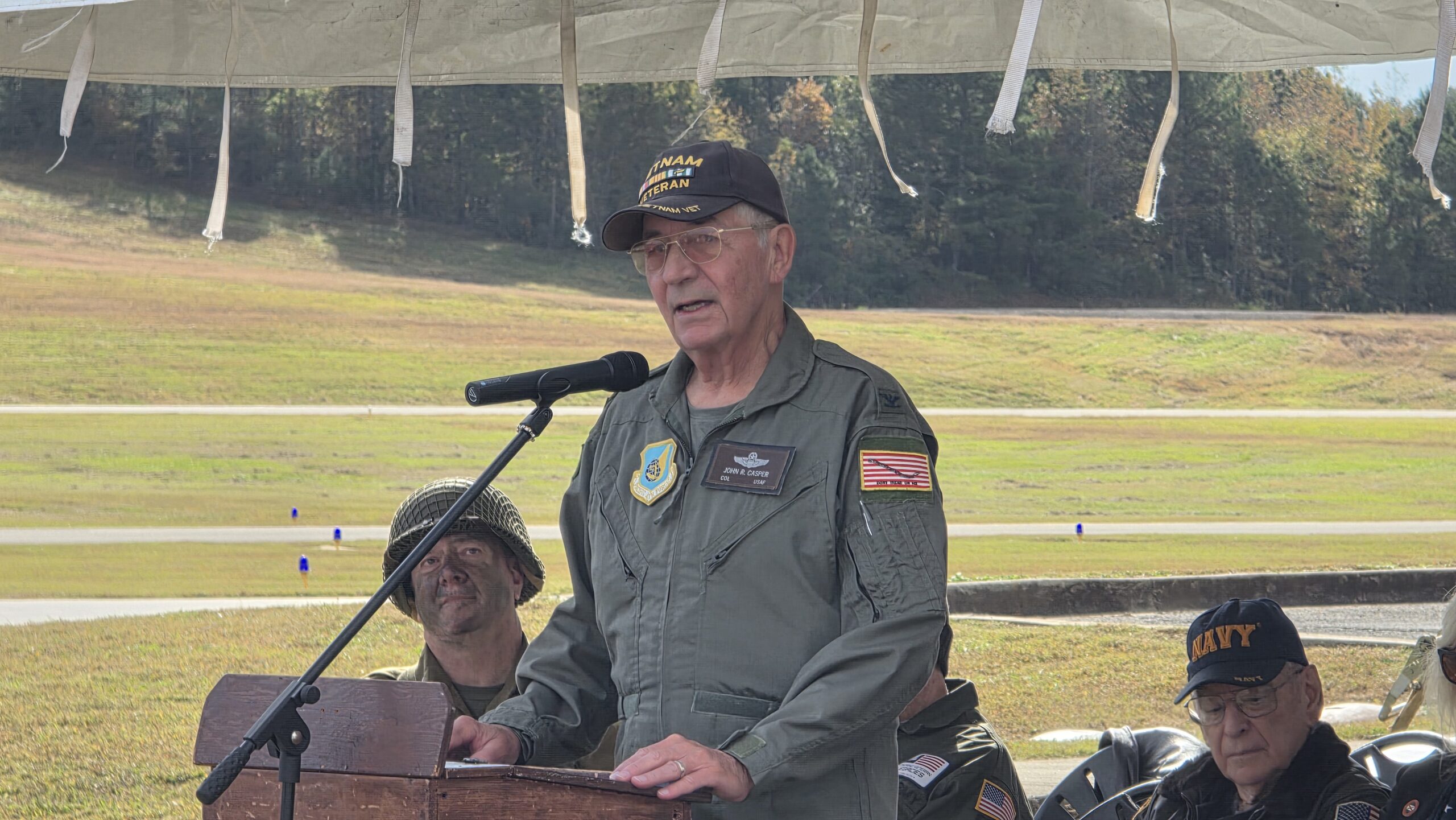
The event’s guest speaker, retired U.S. Air Force Colonel John Casper, a Vietnam veteran and career fighter pilot who flew the F-105 Fighter Bomber, shared with the audience his story of courage and resilience. Casper shared how he was shot down and rescued twice during his service, emphasizing the critical role the A-1 Skyraider aircraft played in both missions.
On Aug. 8, 1966, during his eighth combat mission, Casper was shot down over the jungles of North Vietnam. He described the tense moments that followed and the extraordinary skill of the A-1 Skyraider pilot who accomplished the seemingly impossible: finding Casper’s downed location and guiding the rescue helicopters in to pick him up out of the jungle.
“I thought that was the end of it,” Casper recalled. “I said, ‘Man, that was close, but I still have some more combat missions to fly.’”
Little did Casper know that just 35 days later, he would once again face impossible odds. While flying a mission with three other F-105 pilots targeting a bridge along a railroad line, his aircraft was struck down a second time.
“Everything went fine until we started to roll in on the target,” he said. “That’s when they fired three surface-to-air missiles through our flight. I broke left, the other three broke right. When I recovered, there was no gunfire, and I had no idea where the other airplanes were, but there was the bridge.”
Seeing no groundfire, Casper seized the opportunity to complete his part of the mission, flying in low and dropping his payload, successfully knocking one of the bridge spans into the water. Moments later, he discovered the reason for the silence.
“There was a MiG shooting at me,” he said. To escape, he attempted what he called a “neat maneuver” he’d once heard about — a high-G roll underneath the MiG. The maneuver put his plane nose-down about 3,000 feet above the ground, with barely enough air speed to keep him from hitting the ground.
“It was then I decided to get out of dodge,” he said.
Casper radioed his team, who were roughly 20 miles away, heading toward the coast. They turned back to help, but the two groups never connected. “As luck would have it, they came this way, I went that way and we never saw each other,” he explained. “So, we said we’d just meet over the water.”
As Casper headed toward the coastline, another MiG locked onto him. Knowing he couldn’t outgun his adversary, he went full afterburner — the F-105’s greatest advantage — and made a desperate push for the sea. With the coastline finally in sight but his fuel running low, Casper attempted to rejoin his formation. That’s when things took a turn for the worse.
“I saw my whole world come apart,” Casper said. “I saw part of my wing come off. I could feel the airplane getting hit, and the fire light came on. I just made it across the coast. I stayed with my airplane as long as I could, but I had a fire in the cockpit at that point. I said, ‘It’s time to get out.’”
Forced to eject, Casper pulled the handles that should have launched the canopy and initiated the ejection sequence — but the mechanism failed. With flames in the cockpit and seconds to spare, he made the split-second decision to eject through the canopy itself.
He tumbled violently through the air before hitting the water below. Fighting to the surface, he soon heard the faint, reassuring sound of his emergency beeper, the signal indicating that his ejection seat had separated from the aircraft. That alert let his flight team know he was alive.
However, his flight team was running low on fuel and had to return to the tanker. Before leaving, they radioed to let him know that rescue forces were being notified. Casper knew exactly what that meant — A-1 Skyraiders and a rescue helicopter, a scene he’d experienced once before.
Drifting roughly 20 miles south of China in hostile waters, Casper spent the next several hours alone in his life raft, waiting. The stillness of the sea was shattered when the crack of gunfire broke out in the distance. Moments later, the voice of an A-1 Skyraider pilot came over the radio, letting him know they were attempting to reach him.
“These guys that day were under fire for over 40 straight minutes, making three separate attempts to get to me,” Casper recalled. “Around that time, several boats started coming out from shore — one of them was a big boat, probably 30 or 40 feet long, and it was maybe a quarter-mile away. I figured I was done.”
Just then, two A-1 Skyraiders came roaring in overhead. “I don’t know how they saw me in the water, but they did,” he said. “I pointed out the boat to them, and they turned around and rolled in and blew that boat to smithereens with a bunch of rockets. It was truly amazing.”
The A-1s led the final charge, escorting the rescue helicopter through heavy fire while providing cover from the nearby islands. As the chopper lowered its harness, Casper maneuvered himself into it and began ascending toward safety, only for the winch to fail.
“About halfway up, the winch shorted out and stopped working. So, we’re leaving, I am swinging around underneath this helicopter, the A-1s are on both sides of us and were getting shot at and I’m going, ‘This is not good, but it’s better than being in the water.’”
The helicopter crew quickly repaired the winch and pulled Casper safely into the aircraft. Once aboard, they notified him that they were heading back to a nearby destroyer. From his perspective, however, there was still one “problem.”
“The only problem they had when I got up in that helicopter was that I wanted to hug and kiss everybody and thank them,” he laughed. “But they were busy firing machine guns out the windows, trying to get out of there. They were under fire for about 20 minutes.”
“When we finally got clear, they strapped me to the floor — nicely — gave me two airline miniature whiskeys and told me to take it easy,” he said with a grin.
As night fell and his exhaustion set in, the helicopter finally touched down on a Navy carrier. A spotlight illuminated from the ship’s superstructure, and as Casper stepped out of the aircraft, the ship’s band began to play “The Star-Spangled Banner.” He was finally saved.
“It was unbelievable,” he said. “Out of the darkness came what I found out later was a four-star admiral welcoming me back to the ship. He was on a tour of the ship and for three days, we would go from boat to boat and he would have me with him and he would say, ‘Look what we found.’”
Casper shared that, for many years, he never knew the names of the brave men who had saved his life — from the helicopter crew to the A-1 pilots who risked everything to rescue him. But 36 years later, a chance encounter changed that.
During a reunion, a fellow pilot who recognized Casper from his time flying the F-105s and knew of him being shot down handed him a piece of paper with a name and phone number. The name belonged to the brother of this pilot, who had served as the winch operator on the helicopter that pulled Casper from the water.
“So, I got to meet the entire crew and one of the A-1 drivers at a reunion,” Casper said. “I remained friends with the aircraft commander who saved my life.”
Years later, that commander’s nephew reached out and invited Casper to a family reunion. “I went up there, and the whole reason for having me there was to tell all of his kids, grandkids and family what a brave man their grandfather was,” he said.
“I want to end this way,” he added. “Some people are very reluctant to talk about what they did. I think you have an obligation to let young people know what you did in the military, not bragging about it, but telling them what it was and what it was like. So, I ask all of you, please consider doing that.”
Casper’s words would set the tone for the rest of the day, echoing a sense of reflection, pride and celebration of the many men and women who have similar stories to share. As the day continued, that same spirit carried into a day full of tributes and live events.
Adding to the day’s highlights, retired U.S. Army Col. Don Fallin joined Skydive Alabama for a tandem jump, making a smooth landing to cheers from the crowd. The loud drone of Huey helicopter rides made their return and operated continuously throughout the day, giving attendees a chance to experience the iconic aircraft once flown in Vietnam.
Spectators also enjoyed a variety of impressive flyovers from a team of airline pilots and military veterans based in Atlanta. The Cullman Community Band provided live music during the veterans’ lunch, while food trucks and local organizations lined the grounds offering treats, candy and information about programs supporting local veterans and various other organizations. Historical reenactors also walked the grounds, engaging with attendees and sharing stories from the eras they represented, offering a glimpse into what life was like during those times.
Event organizer and veteran Ken Brown, a retired U.S. Air Force colonel, said the turnout and atmosphere made this year’s celebration one to remember.
“We had great weather for our veterans celebration this year,” Brown said. “All who attended enjoyed good food, good music and historic vintage aircraft. Most important of all, our veterans felt honored and appreciated — something they and their families have more than earned. Next year, I’d like to see double the crowd turnout.”
For more information or updates on future Veterans Day celebrations, visit www.cullmanveteransday.com. For more information on the local Cullman Veterans of Foreign Wars Post 2214, call 256-739-6611 or email commandervfwpost2214@outlook.com.